By Kevin Seguya
International Labour Day is intended to recognize and appreciate workers’ contribution to the national development and to raise awareness about the workers’ rights and responsibilities.
The International Labour Day celebrations will be held at Nkoyoyo Boarding Primary School Grounds in Matale, Buikwe district, and will be presided over by H.E the President of the Republic of Uganda, Yoweri Kaguta Museveni. The celebrations will be held under the theme, ‘Safeguarding Uganda’s progress, empowering the workforce and promoting decent work for competitive enterprises.’
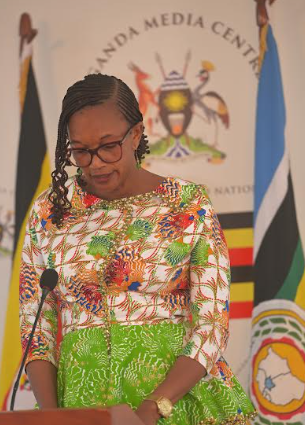
The Minister of State for Labour, Employment and Industrial Relations, Hon. Esther Davinia Anyakun, speaking during a press conference at Uganda Media Centre on Tuesday, April 28, 2026 said as the country commemorates this day, it will be used to reflect on the opportunities and challenges in Uganda’s labour market.
Anyakun said that according to the 2025 Market Survey Report, this day finds Uganda at 58.1% which is 26.4 million, which is the working age population and unemployment stands at 12%. The minister said labour force participation remains relatively low at 43.2%, reflecting the structural constraints in labour market absorption. Youth exclusion is particularly pronounced, with around 42.6% of those aged 15-24 years not in employment, education, training and also that unemployment is higher among females compared to males.
Anyakun said Uganda’s labour market is largely informal, the sector contributes about 54.5% of the GDP and employs nearly 88% of the workforce. As a result, the majority of workers remain vulnerable, with limited access to labour protection, which is compounded by gaps in awareness and enforcement of labour rights, as a significant proportion of workers continue to face hazardous conditions and working abuses.
Social protection coverage remains limited, although 3.2 million workers are registered under the Retirement Benefits Scheme, with most under the National Social Security Fund (NSSF). Only a fraction are actively contributing, leaving many workers exposed to income insecurity at old age.
On productivity, overall labour productivity in Uganda remains below both regional and global average. This underscores the need to sustain efforts, to enhance productivity across all sectors, in line with the ambitions of the Fourth National Development Plan (NDPIV).
Meanwhile, Anyakun said Uganda has made steady progress towards the attainment of middle-income status, by expanding monetization of the economy, by reducing poverty levels and establishing a robust legal policy framework, to guide national development. Anyakun added that these achievements have laid a firm foundation, to sustain economic transformation, strengthen enterprise competitiveness and enhance productivity, while advancing the principle of decent work for all Ugandans.
Anyakun said, as the ministry, various conferences are ongoing and visits are being undertaken to various factories to see how workers’ conditions may improve. As this day is commemorated, it is important to reflect upon the latest national data, to appreciate the opportunities and challenges within the labour market.
According to the National Population and Housing Census 2024, Uganda’s population stood at 45.9 million and over 73% of the population is below the age of 30, underscoring the country's predominantly youthful demographic structure.
This demographic structure presents an opportunity and a challenge, as the country generates sufficient, productive and decent jobs to absorb the rapidly growing labour force. Labor Day is also known as International Workers’ Day and May Day.
Labour Day is a public holiday, in many countries worldwide. It usually occurs around 1st May, but several countries observe it on other dates. Government, through the Ministry of Gender, Labour and Social Development continues to implement the following programs to implement decent work and enhance productivity.
The implementation of the National Apprenticeship and Graduate Volunteer Programme (NAGV) aims at developing skills manpower, with practical and market relevant skills. Secondly to empower informal businesses into formal growth, and enhancing labour productivity for national competitiveness and human capital development. On this day, the ministry will carry out activities, including workplace inspections, barazas, worker conferences and tree planting initiatives. The minister urged all Ugandans to participate in the celebrations, as they recognize and honor the contribution of Ugandan workers in national development.
“I urge all Ugandans to embrace the upcoming Labour Day celebrations,” she concluded.
The writer works for Uganda Media Centre
