img
31 October 2025

PRESIDENT MUSEVENI ENDS KARAMOJA CAMPAIGN TRAIL WITH CALL FOR PEACE, WEALTH CREATION AND FREE EDUCATION

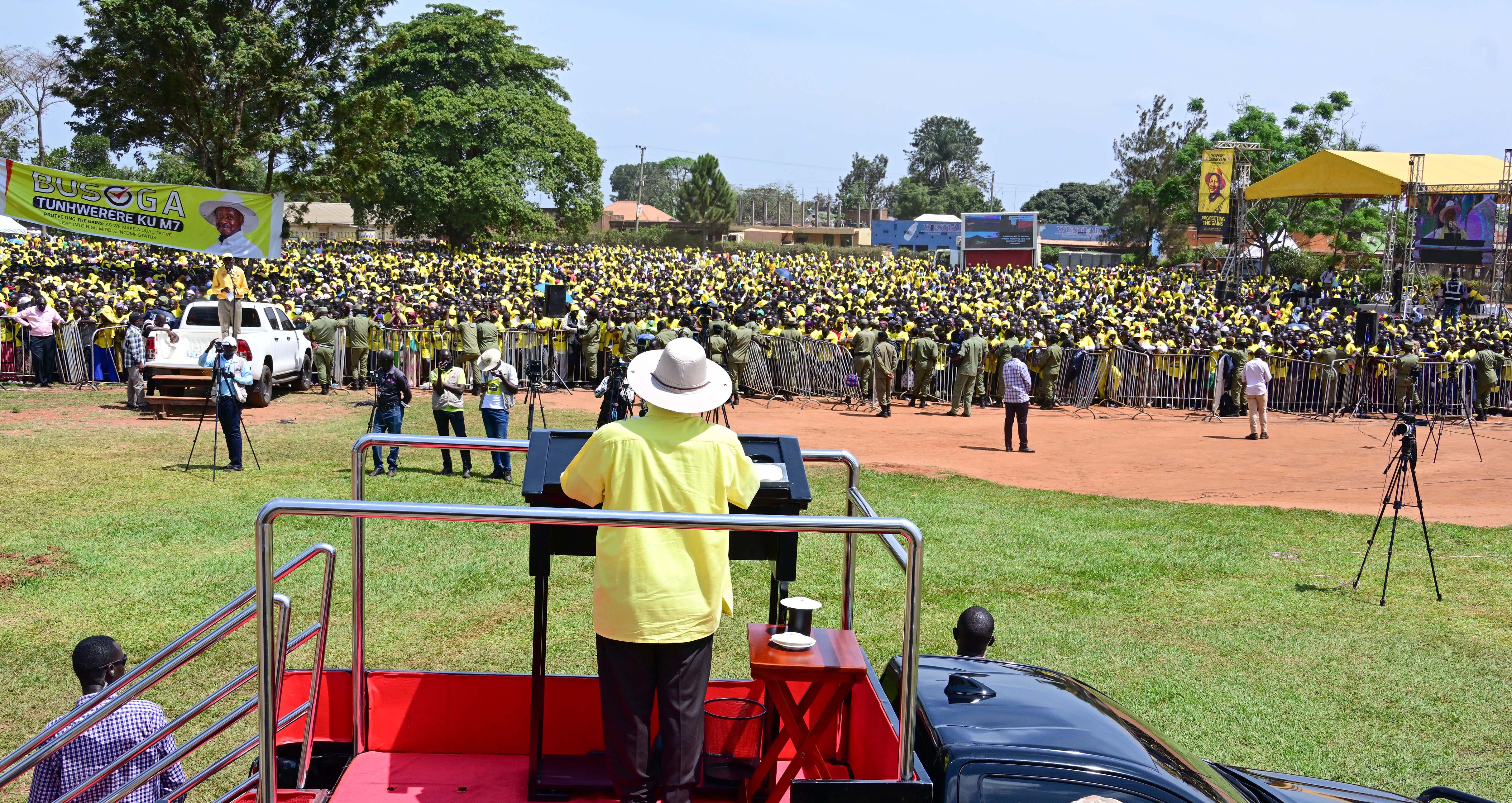
President Yoweri Kaguta Museveni braved a heavy downpour on Thursday 30th October 2025, as he addressed his final campaign rally in Karamoja, delivering a passionate appeal for peace, wealth creation, and the consolidation of the National Resistance Movement’s (NRM) achievements in the region. The rally, held at Matany Grounds in Napak District, drew thousands of enthusiastic supporters who cheered as President Museveni, soaked but undeterred, declared, “I've been a cattle keeper since the age of four and I don’t fear the rain. In Ntungamo, when you abandon the cows to go for shelter, the cows will go to the gardens, destroy people’s crops, and that becomes a crime.” The NRM Presidential candidate reflected on peace and stability, revisiting the painful history of insecurity in Karamoja and the struggle to disarm armed warriors. “There were arguments that we should leave you with guns to protect yourselves from fellow rustlers from neighboring countries,” President Museveni recalled. “But I said No, that is suicide. You have now seen the results.” He thanked the people of Karamoja for supporting the disarmament campaign, describing it as a historic contribution to national unity and security. “I remember a function at Kangole where many people came to hand over guns, and women played a big role for the peace of Karamoja. Recently, even the Karachunas came out and handed over guns, thank you so much,” he said, noting that peace in Karamoja has contributed to harmony across Uganda. President Museveni emphasized that Uganda’s progress rests on the NRM’s founding principles of patriotism, Pan-Africanism, socio-economic transformation, and democracy. He described himself as a “wealth creator” who depends on his own labor and the markets of fellow Ugandans. “I have looked after my ancestors’ cattle since I was four. I depend on myself. All I need from other Ugandans is a market to buy my milk, beef, and bananas. Anyone who buys my products is helping me to be rich,” he said. “I’m glad the NRM accepted this ideology, and that’s why Uganda is stable and developing,” President Museveni said, drawing applause from the crowd. Highlighting progress in education, candidate Museveni outlined that Napak District has 30 government primary schools, 44 private primary schools, 3 government secondary schools, and 1 private secondary school. He said the government was constructing five new secondary schools, which will leave only six sub-counties without a government secondary school upon completion. “The plan is to have one government secondary school per sub-county and one technical school per district. What has been achieved is noted, and what has not been done will be done. That’s why we are asking you for your support,” President Museveni told supporters. However, he expressed disappointment at those sabotaging his vision for free education. “For a long time, I wanted free education in government schools,” he lamented. “But some school managers have turned everything into money. They charge unnecessary fees and block children from studying.” To counter this, H.E. Museveni said he started Presidential Skilling Hubs, one of which is in Napak to train youth for free. “These children had lost hope because they lacked school fees. But after six months of training, they are making shoes, furniture, hospital beds, and bags - items that were being imported from China and India,” he said. He urged voters to insist on free education in government schools, warning that school charges were “destroying the future of young Ugandans.” On health, President Museveni said Napak’s 14 sub-counties had only five Health Centre IIIs, leaving nine sub-counties without a health facility. He announced plans to upgrade several facilities such as Nabawal HCII to HCIII, Ngoleriet HCII to HCIII, Lokiteded HCII to HCIII, and Morulinga HCII to HCIII. Some of the ongoing works include upgrading Iriiri HCIII to HCIV. “In the next term, every sub-county will have at least a health centre III, and Napak will have its own hospital,” President Museveni promised. Shifting to household income and wealth creation, the President drew a sharp contrast between development and wealth, explaining that while development projects are government-led, wealth creation is personal. “There’s a tarmac road in Matany. But do you sleep on a tarmac road? No. You sleep in your houses, and the poverty you left there welcomes you back. Development is ours, but wealth and poverty are yours,” he emphasized. President Museveni reiterated the NRM’s long-standing message of commercializing small-scale farming through the four-acre model, which encourages families to engage in dairy, poultry, horticulture, and cash crops. He cited success stories from across Uganda, including George Matongo of Nakaseke, an uneducated farmer who earns UGX 250 million annually from selling 900 litres of milk per day, and Korea Dick of Abim, who earns UGX 12 million annually from mango farming, selling to the Soroti Fruit Factory. “These are examples of people who listened to our message. So, I appeal to you, chase poverty from your homes,” he said. Regarding the issue of jobs, the President emphasized that jobs come from wealth, not merely from government employment. He cited Hon. Fred Byamukama of Kakumiro District, who runs a four-acre model farm with cows, poultry, bananas, and piggery. From eggs alone, Hon. Byamukama earns UGX 55 million in profits per month, about UGX 700 million a year, and employs 26 people. “This man, who had no job himself, is now employing 26 people. The wealth of Byamukama is creating jobs for 26 other Ugandans. So, if you want to know where jobs come from, they come from wealth creation, like commercial agriculture,” H.E. Museveni said. He contrasted this with the limited 480,000 government jobs, compared to the 1.3 million jobs created by Uganda’s growing factories. President Museveni praised the First Lady and Minister of Education and Sports, Maama Janet Kataaha Museveni for her voluntary work in Karamoja. “I appointed a minister for Karamoja, but he declined, thinking it was a demotion. But Maama Janet accepted and worked hard. She built water dams and improved food security. When she was here, Karamoja even started sending food to Mbale,” H.E. Museveni said. He announced a new plan to expand individualized water systems for commercial farmers in Karamoja to promote irrigation and resilience against drought. “I appeal to you to continue supporting the NRM so that we can consolidate what we have done and also do more. The rest will be done,” President Museveni said. Taking the podium, Maama Janet thanked Napak residents for their unwavering support for NRM. “All Ugandan adults have a responsibility to protect this peace and unity for the continuation of development,” she declared, urging the residents to re-elect President Museveni and NRM leaders in the 2026 elections. “Remember, we all have the responsibility to vote for this President and all NRM leaders so that we can build and transform Uganda. God bless Napak, Karamoja, and Uganda. Arakara noi!” The NRM Vice Chairman for Karamoja, Hon. Lokii John Baptist, congratulated President Museveni for successfully concluding the regional campaigns. “Napak and Karamoja are celebrating the achievements of NRM over the years,” he said, adding that Napak is willing to push close to 100% vote. The NRM Chairman for Napak District, Mr. Mark Longole presented a report showing visible transformation in Napak’s sectors such as education, health, water, security, and peace. He revealed that UGX 17.83 billion in Parish Development Model (PDM) funds had been disbursed to 17,867 beneficiaries across 57 SACCOs, representing 42.8% of households in the district. Napak has also benefited from programs such as Emyooga, Youth Livelihood Programme (YLP), Women Entrepreneurship Programme, and SAGE for the elderly. On the Emyooga, the district has 34 SACCOs with 9,195 members, who have so far received UGX 1.16 billion. Mr. Longole thanked the government for integrating 2,114 former warriors after disarmament, noting that peace has unlocked development potential across the district. Despite the progress, he tabled several requests to the President which included, creation of a new district, Iriiri separate from Napak, construction of a district hospital, restocking of households affected by disarmament, and strengthening youth SACCOs with UGX 2.5 billion as a revolving fund. Other requests were the extension of electricity to the remaining sub-counties and the resolution of the long-standing land dispute between Napak and Teso. Napak district remains one of NRM’s strongest areas. In the 2021 Presidential Elections, out of 56,678 registered voters, President Museveni secured 32,490 votes (94.1%), while the National Unity Platform (NUP) managed to get 912 votes (2.6%). According to the 2024 census, Napak has a population of 211,830, and the number of registered voters has increased to 62,688 in 2025, up by over 6,000 new voters. The district now has 181 polling stations, up from 145 in 2021, signaling administrative expansion and voter mobilization progress. Several government officials attended the rally, and they included Hon. Peter Lokeris (Minister for Karamoja Affairs), Hon. Florence Nambozo (State Minister for Karamoja), Hon. Balam Barugahara (State Minister for the Youth and Children Affairs), and Hon. Akello Rose Lilly (Ethics & Integrity). Others were Members of Parliament, local district leaders, and security chiefs.

img
30 October 2025

PRESIDENT MUSEVENI DECLARES: “CRIMINALS WILL NEVER BE A PROBLEM AGAIN IN KARAMOJA”

President Yoweri Kaguta Museveni has assured Ugandans that insecurity and cattle rustling in Karamoja are permanently defeated, declaring that criminals will never be a problem again under the National Resistance Movement (NRM) government. The President made the remarks while addressing journalists in Karamoja subregion at the Morulinga State Lodge, Napak District on Wednesday, October 29, 2025. The address was part of his ongoing campaign trail ahead of the 2026 general elections. In his detailed briefing, President Museveni traced the historical roots of cattle rustling and the resurgence of insecurity in Karamoja, attributing them to systemic failures in earlier administrations and corruption within local security structures. He noted that upon his direct intervention, the government restored order and neutralized the rustlers who had destabilized the sub-region. “But when we came, there was corruption in the army, starting with the failure to pay the vigilantes. When we came to Barlegi, we found the real problems, and of course, the army had the capacity to defeat these people, and we defeated them,” the President said. H.E. Museveni explained that the Uganda People’s Defence Forces (UPDF), working hand-in-hand with local communities, managed to restore security in the region. He revealed that during an earlier period when the UPDF 5th Division went for training, some rustlers tried to take advantage of the temporary gap, but they were swiftly defeated. “They learnt a lesson, and anybody who tries will be defeated as long as the NRM is in charge,” H.E. Museveni said firmly. The President underscored the need for effective community policing and robust communication systems at the grassroots. He expressed concern that some sub-counties in Karamoja still lacked a sufficient police presence, despite a standing directive that each sub-county should have at least 18 police officers. “The lack of community policing in some areas has been due to incomplete deployment of police officers,” he noted, adding that improved communication technology provides a new frontier in crime prevention. “It’s not really difficult to deal with these criminals, especially now that we have a good network of telephones. This good network is very important in anti-crime efforts,” President Museveni said, adding that every sub-county should center security around the police station, where everyone knows the emergency telephone number. “If anything happens, people should ring immediately,” he said, emphasizing that the police must be well-equipped with means of mobility, such as motorcycles and pickup vehicles, to respond swiftly to incidents. In addition, he recommended the deployment of police dogs and surveillance technology such as drones and aircraft to track criminal activity. “If the criminal has already left, the police dog can follow. At another level, we have surveillance equipment like UAVs and aircraft that can fly by day or night. There’s no way criminals can manage. If you combine all this, there’s no way they can survive,” the President stated. President Museveni added that modern surveillance technology has made it nearly impossible for rustlers to hide. “Some commanders said these rustlers are now staying in the bush instead of their homes, but that’s even easier because if they use a telephone, you can locate it. That telephone becomes a death trap for them,” he warned. Regarding national politics, candidate Museveni attributed the NRM’s enduring popularity to its consistent ideological foundation built on four key pillars — patriotism, Pan-Africanism, socio-economic transformation, and democracy. “The big support of NRM that you are seeing is because of our work for the last 65 years. I have been active since 1960. Initially, I was a member of the Democratic Party (DP), which was promoting a sectarian cause. I told them that the federal system they were talking about was dangerous for a young country like Uganda. We needed unity,” he said. He recounted the political chaos of the early 1960s, when sectarianism dominated Uganda’s politics through parties like DP, UPC, and Kabaka Yekka, explaining that the coalition politics of that time sowed seeds of division that later erupted into violent conflict. “By 1964, Obote discovered that what he had promised Buganda could not be done, things like having its own High Court and police force. Those were ridiculous ideas. When he failed to implement them, the fallout led to the 1966 crisis,” he explained. President Museveni linked the NRM’s political philosophy to its development agenda, saying Uganda’s transformation is anchored on household wealth creation and value addition through agriculture and industry. “My first plan is wealth. That’s what I did in the cattle corridor in the 1960s. For economics, I say: Seek ye first the homestead incomes, and the rest shall be added unto you," he said, outlining a detailed model for household prosperity based on the “four-acre model plan”, urging every family to engage in commercial agriculture. “Each home must engage in commercial agriculture, using high-value enterprises. The first acre can go to coffee, the second to fruits, the third to pasture for zero-grazing cows, and the fourth to food crops like cassava. Then you can add backyard poultry, piggery for those who eat pork, and fish farming in wetlands,” he elaborated. The President highlighted the NRM’s ongoing push for industrialization, particularly agro-processing industries that add value to agricultural produce. “The factory is based on agriculture. If you produce a lot of milk, coffee, and fruits, you must process them,” he said, adding that agro-processing will link with the rural economy. He also mentioned that Karamoja and its surrounding regions have vast potential for mineral-based industrialization. In addition to agriculture and industry, the President identified tourism as another key economic pillar for Karamoja’s development. “We have natural beauty and culture here that can attract visitors. Tourism will complement agriculture and mining,” he said. President Museveni reiterated that Uganda’s progress cannot be isolated from Africa’s unity and economic integration. He said the NRM’s vision extends beyond national borders and seeks to promote a self-sustaining African market.

img
30 October 2025

PRESIDENT MUSEVENI IMPRESSED BY IMPROVED WATER ACCESS IN NAKAPIRIPIRIT, APPLAUDS NRM’S TRANSFORMATIVE WORK

President Yoweri Kaguta Museveni has expressed delight over the remarkable improvement in water access across Nakapiripirit District. He described it as proof of how the National Resistance Movement (NRM)'s long-term investments in infrastructure are transforming lives in Karamoja. Speaking during a campaign rally at Namboole II Grounds in Nakapiripirit yesterday, President Museveni, who is also the NRM Presidential flag bearer, said he was impressed to learn that 82% of villages in the district now have access to safe water, one of the highest coverage levels in the subregion. “I was looking at water coverage, and I’m happy to see that Nakapiripirit is doing well. Out of 209 villages, 172 have access to water. This 82% is very good. Some districts like Amudat and Abim are still lower, but we shall study why and address it,” said President Museveni who was in the company of the First Lady and Minister of Education and Sports, Maama Janet Kataaha Museveni. He noted that the progress reflects the government’s deliberate effort to provide economic and social infrastructure to all corners of Uganda, especially previously marginalized regions. Under the NRM government’s Water for Production initiative, he mentioned that several major facilities have been completed in Nakapiripirit, including the Aooyalet Valley Tank in Loregae Sub- County with a capacity of 40 million litres, and the Komaret Valley Tank in Moruita holding 20 million litres. “Four additional valley tanks Karengeze, Lomogol, Lokitela-Alokwa, and Lomosomosoi as well as a wind-powered abstraction system have also been completed,” he said. Looking ahead, the President revealed that the government is finalizing plans for the Namalu Large Scale Irrigation Scheme, which will store 11.8 billion litres of water and irrigate up to 750 hectares under Phase One. “These are the kinds of interventions that ensure water is not just for drinking but for production to support farming and livestock,” the President said. President Museveni emphasized that the NRM’s development philosophy rests on building economic and social infrastructure to create the foundation for wealth creation. He pointed out that Nakapiripirit has benefited from new roads, electricity connections, and telecommunication networks that have opened up the area to trade and services. Among key road projects completed in the district are Namalu–Nakapiripirit (17 km), Akisim–Moroto–Lokitanyala (92 km), and the ongoing Muyembe–Nakapiripirit (92 km) road upgrade. “These roads are not just for decoration, they are for movement of goods, services, and people. They are the arteries of the economy,” he said. On social infrastructure, the President highlighted the construction of schools and health centers to bring essential services closer to the people. “Nakapiripirit currently has 27 government primary schools and seven government secondary schools, while the Ministry of Health is upgrading several lower-level facilities to Health Centre IIIs and IVs to improve service delivery,” he said. Turning to household income, President Museveni called on the people of Nakapiripirit to embrace commercial agriculture and enterprise development, saying that wealth creation must begin at the homestead. He cited examples like Hon. Fred Byamukama, the State Minister for Transport, who earns over Shs 55 million per month from poultry farming, as proof that agriculture can be highly profitable when approached commercially. “Please listen carefully to the NRM message. Plan number one is commercial agriculture. From there, we go to manufacturing and then services, including digital. These are the pillars that will transform Uganda,” he said. He also praised the impact of the Presidential Zonal Industrial Hubs, where youth are acquiring practical skills for self-employment. Gloria Nayol, a beneficiary from Napak Industrial Hub, shared her story of how a tailoring course changed her life. “After completing my training, I started my own small business with friends. We later received Shs 50 million through the Graduate SACCO. We are buying materials and expanding. Thank you, President Museveni, for supporting us,” she said. Karamoja is Home: On her part, Maama Janet described her visit to Nakapiripirit as a “homecoming,” expressing gratitude for the warmth and progress she witnessed in the region. “Coming to Karamoja is always a homecoming for me. I thank you for the traditional love and warmth of the Karamoja people that I cherish so much,” she said. Maama Janet noted that the transformation in Karamoja from insecurity and hunger to stability and productivity reflects God’s grace and the NRM’s commitment to inclusive development. “The new generation of Karamoja must live in better houses, have better food and livelihoods. Karamoja has always been a blessing to me. God bless Karamoja, and God bless Uganda,” she added. The Speaker of Parliament, Rt. Hon. Anitah Among, who also serves as the NRM’s Second National Vice Chairperson (Female), commended the government for improving social services in the subregion. She particularly praised the district’s new mobile laboratory and the modern emergency units at Moroto Hospital, describing them as life-saving facilities that reflect tangible progress. “When you see the road from Mbale–Muyembe–Nakapiripirit, it is one of the best roads. We have security, development, and a conducive environment to create wealth. We thank you, Mzee, for your leadership,” she said. Mr. Lochap Daniel Matovu, the NRM Chairperson for Nakapiripirit, said residents remain firmly behind President Museveni, citing the district’s 94.8% support in the 2021 elections. He said Nakapiripirit’s progress under NRM from education and health to water and roads is visible and unmatched. According to district data; Nakapiripirit has 9 sub-counties, 35 parishes, and 209 villages with a population of 111,681 people. Through the Parish Development Model, the district has received Shs 10.5 billion, benefiting over 10,300 households. Under Emyooga, 35 SACCOs with 8,635 members have received Shs 1.78 billion to support small enterprises. “We are determined to protect these gains as we move towards achieving middle-income status,” Mr. Matovu said. As the campaign rally concluded, President Museveni urged the people of Nakapiripirit to stay on the course with the NRM, assuring them that the government will continue expanding infrastructure and wealth creation programs to uplift every household. “What we have done here in Nakapiripirit shows what happens when people and the government work together. Let’s continue building on these foundations,” he said. Meanwhile, the campaign is running under the theme: “Protecting the Gains, As We Make a Qualitative Leap into High Middle-Income Status”. The event was graced by NRM Central Executive Committee (CEC) members, Members of Parliament, religious and cultural leaders, as well as thousands of supporters.

img
29 October 2025

PRESIDENT MUSEVENI HAILS NABILATUK FOR UNWAVERING SUPPORT TO NRM, HIGHLIGHTS PARTY’S ACHIEVEMENTS

President Yoweri Kaguta Museveni has commended the people of Nabilatuk for their unwavering support to the National Resistance Movement (NRM) and tasked them to overwhelmingly vote for the party for another term in office because of its clarity on leadership strategies and society dynamics. ‎ ‎He explains that the NRM has so far established a clear wealth creation strategy which no other contender for leadership has been able to counter. President Museveni also highlighted NRM’s achievements which include among others, restoring lasting peace in Karamoja and Uganda at large. “You all are witnesses to how the NRM has been able to create peace in Karamoja and in the rest of Uganda,” he said. The President in the company of the First Lady and Minister of Education and Sports, Maama Janet Museveni made the remarks today during a campaign rally held at Lolachat Primary School Playground, Nabilatuk District. President Museveni noted that after peace, the NRM’s second major contribution to Uganda has been development, which he said comprises two critical aspects — economic infrastructure and social infrastructure. “Here in Nabilatuk, you have seen what has been done, such as the tarmacked road, improved water facilities, schools, and health centres,” he said. President Museveni however observed that access to safe water in Nabilatuk still lags behind that of neighbouring Nakapiripirit District. “Out of 96 rural villages, 44 have access to safe water — that is 46%. In Nakapiripirit, it is 82%. You should find out why,” he said. He noted that Nabilatuk currently has one piped water system, with three piped water designs completed so far. Dams such as Longorikipii and Arengetekat have each been constructed with a capacity of 20,000 cubic meters. The government has also built smaller reservoirs at Aputiputi, Najonai-Kalakal, Nakikokolyae/Kamosing,Namata-Alomaa, Nangorit, and Sakale/Nakoko, each with a capacity of 10,000 cubic meters. Additionally, a valley tank at Napayan has been completed with a capacity of 20 million litres, and a solar-powered irrigation system is under construction to support agricultural productivity in the district. On education, President Museveni reiterated the government’s commitment to ensuring free education for all Ugandan children under the Universal Primary Education (UPE) and Universal Secondary Education (USE) programs. “Under UPE, we are supposed to have free education, but some people keep charging fees, which makes children drop out of school. I don’t like this. The NRM wants mass education for everybody,” he said. He therefore appealed to the citizens to support his initiative of fully enforcing free education in all government schools, adding that the government had already established innovation hubs, such as one in Napak District, to promote skills and technology among learners. Nabilatuk currently has 17 government primary schools and three government secondary schools, including the newly completed Lolachat Seed Secondary School. “The plan of the government is to have one primary school per parish and one secondary school per sub-county. The NRM line is mass education for everyone,” he said. President Museveni noted that while Uganda initially promoted day schooling across the country, Karamoja might need boarding sections due to security challenges. “We shall discuss and see what can be done — perhaps make Karamoja have boarding sections for some time and, after 10 years, review whether the model can be applied elsewhere,” he added. On health, the President praised the region’s progress in immunization, which he said had significantly contributed to population growth. “When I first came to campaign in Karamoja in the 1980s, the population was 190,000. Today, it stands at 1.3 million,” he said. He announced that the government will upgrade Lolachat Health Centre II to Health Centre III, and is also undertaking the construction of Natarie HC II, Nayonai Angikalio HC III, Lorengedwat HC III, and Nabilatuk HC IV. On the other hand, President Museveni urged residents to embrace wealth creation as a personal responsibility distinct from public development. “You must add wealth creation alongside development because you can have development and still remain poor. Development benefits everyone, but wealth creation is for an individual,” he explained. He encouraged people to engage in commercial agriculture, manufacturing, ICT, and services such as transport and hospitality, which he said are creating millions of jobs across the country. “The government employs about 480,000 people, but factories alone employ 1.3 million — almost four times that number,” he noted. The President also addressed local concerns over grazing rights in protected areas, following complaints that the Uganda Wildlife Authority (UWA) had restricted communities from grazing alongside wildlife. “They told me UWA wants to stop them from grazing in the park because they graze side by side with animals. I said they can continue grazing as we discuss with elders to find the right balance,” he said. He, however, reminded residents that tourism was also a valuable asset for the sub-region. On her part, Maama Janet thanked the people of Nabilatuk for their warm reception and love for the NRM government. “When I come to Karamoja, for me it is homecoming. Thank you for receiving us with traditional songs,” she said. Maama Janet also reaffirmed that the NRM government deeply values the people of Karamoja and urged them to safeguard the peace achieved under the leadership of President Museveni. “It is our responsibility to protect that peace and not take it for granted. We have not forgotten how we used to walk through these bushes encouraging the Karamojong to grow food for their families instead of depending on the World Food Programme,” she said. Furthermore, the First Lady commended the people of Karamoja for embracing food production and urged them to continue striving for self-reliance. “I am happy that now you are producing food and even keeping surplus in your granaries. The work of the NRM now is to help the Karamojong make a qualitative leap — from grass-thatched houses to modern homes,” she added.

img
28 November 2025

PRESIDENT MUSEVENI UNVEILS INDIVIDUALIZED WATER PLAN FOR WEALTH CREATORS IN KARAMOJA, PLEDGES MORE ROADS, SCHOOLS AND HOSPITALS

President Yoweri Kaguta Museveni has unveiled a new government initiative to establish individualized water systems aimed at supporting commercial farmers and small-scale producers, as part of a broader effort to eradicate poverty through wealth creation and self-sufficiency. Addressing thousands of supporters during a campaign rally at Kalas Girls Primary School in Amudat District, Karamoja Sub-region, on Tuesday 28th October, 2025, H.E. Museveni said the government was developing a plan to ensure every productive household has access to reliable water for production, a move he said would mark a turning point in Uganda’s rural transformation strategy. “We are working out a plan for water for rural areas. Apart from the valley dams, people need water at each home,” President Museveni said. “The communal water systems will not address their water problem. We are trying to analyze how we can provide individualized water for wealth creators. In the Ankole area, we no longer use those communal dams. If you come to Rwakitura, you will see I have three of my own dams because animals, when they go too far, they get diseases like ticks,” he added. The new policy seeks to end decades of dependency on shared water facilities in semi-arid regions like Karamoja, where boreholes and valley dams are often overstretched or dry up during prolonged droughts. “Borehole water is still very low at 18%. The Minister of Karamoja must find out what the problem is, because in other districts like Abim and Karenga, the percentage is much higher,” President Museveni said. Government data indicates that only 18% of Amudat District’s 415 villages currently have access to safe water, leaving 81.7% without a clean source. Of the existing water-for-production infrastructure, one solar-powered irrigation system has been completed at Katotin, 12 valley tanks have been constructed, and two wind-powered abstraction systems have been installed. Major recent projects include the Kosike Valley Dam, with a capacity of 2.7 billion litres, and the Kaechom Valley Dam, which holds 1.8 billion litres. Ongoing projects include additional solar-powered irrigation systems and a large valley tank under construction. The Lowoyakur Dam, shared with Nakapiripirit, will hold 1.4 billion litres of water once completed. Peace as the foundation of development: Throughout his address, President Museveni emphasized that peace, the first of seven core achievements highlighted in the NRM’s 2026–2031 manifesto, remains the cornerstone of Uganda’s development. “If you want to know that miracles are possible in Africa, come to Karamoja and come to Amudat. I thank God for making me somehow connected to that miracle,” President Museveni said, while revisiting Uganda’s turbulent past. He explained how the National Resistance Movement (NRM) restored peace and national unity after decades of instability, where, before 1986, Uganda’s electoral and administrative systems were poorly aligned, leading to marginalization in areas like Karamoja. “Before the coming into power of NRM, there were no permanent constituencies. They would just make ad hoc constituencies to favor certain parties. In 1989, we decided that each constituency must be equal to a county. At that time, there were 149 counties in the whole of Uganda, and something called Upe was one of them with a population of only 20,000. Some of the counties in the south, like Bukoto, had 360,000 people. But we said that for now, let’s start with the counties, and that’s how Upe became a constituency,” President Museveni said. He highlighted Amudat’s recognition as a district stemming from the government’s respect for cultural and linguistic diversity. “These people are Pokot, and their language is different from Karamojong. Let them have their district and speak their Pokot language there. When I come today and see that the population of Amudat has grown to 203,000, I say this is a miracle,” President Museveni said. Disarmament and border security: President Museveni credited Uganda’s peace to firm decisions such as the disarmament of Karamojong warriors in the early 2000s. He dismissed arguments that communities in Karamoja and neighboring Turkana, Pokot, or Toposa areas should be allowed to keep guns to “balance terror.” “Some said if Karamojong and Turkana both stay with guns, they will stabilize by killing each other. But why have a government if people must protect themselves?” he asked. “And this was a false argument because, like in West Nile, there’s peace, despite the wars in South Sudan and Congo, West Nile is peaceful. Even Kasese and Bundibugyo are peaceful, yet there are wars in Eastern DRC. So, that’s when I insisted that you bring the guns; I will protect you against the Pokot of Kenya, Turkana of Kenya, and others,” President Museveni added, noting that when the Turkana killed three people, including surveyors, he banned them from grazing in Uganda. President Museveni said he had since raised the issue with Kenya’s President William Ruto, demanding that the Kenyan government compensate the victims’ families. “I could not accept this impunity of criminality. I told President Ruto that if these criminals don’t have money, the Kenyan government must pay. I will perform a ceremony in Karamoja here with President Ruto for the Kenyan government to pay for the lives of our officers who died,” President Museveni said, adding that the ceremony will also attract elders to cleanse the blood of the people who died, and the bishops and the sheikhs will also come in and contribute spiritually. Turning to infrastructure, President Museveni vowed to ensure all major roads in Karamoja remain passable year-round. “I have warned the Ministry of Works and the Ministry of Local Government that I don’t want to hear of a major road that is impassable. It may not be tarmac, but it must be motorable all the time,” he said. Recent road achievements in Karamoja include 180.4 km of newly paved roads, such as Nadunget–Iriiri (65.6 km), Kokeris–Matany (5.5 km), Namalu–Nakapiripirit (17 km), and Akisim–Moroto–Lokitanyala (92.3 km). Currently under construction are the Moroto–Lokitanyala (42 km) and Muyembe–Nakapiripirit (92 km) roads. Several other routes are under procurement, including Kaabong–Kapedo–Karenga (67 km) and Kotido–Kaabong (64 km), while the Moroto–Tochi–Atiang–Opit–Awo (94 km) and Kotido–Abim–Aloi–Lira (99 km) roads are under design. President Museveni said the government would also tarmac the Nakapiripirit–Amudat road, a key artery for trade and connectivity in the region. President Museveni reaffirmed the NRM government’s commitment to universal access to education, saying the ultimate goal is to ensure one primary school per parish and one secondary school per sub-county. Currently, Amudat District has 27 government primary schools, 8 private primary schools, 2 government secondary schools, and 1 private secondary school. Out of 44 parishes, only 11 host at least one government primary school. However, three new Seed Secondary Schools are under construction, which will reduce the number of sub-counties without a government secondary school from 9 to 6. The President said he intends to abolish the practice of charging fees in government schools, calling it an injustice against poor families. “When we introduced UPE in 1996, we wanted children to study for free. But school managers started bringing money again,” he said, adding that in the coming government, he would like to stop the charging of fees in government schools. In the health sector, President Museveni noted that Amudat District currently has one Health Centre IV and three Health Centre IIIs, leaving seven sub-counties without any health facility. To close this gap, the government plans to upgrade and construct several facilities, including: Upgrading Karita HCIV to a General Hospital, upgrading Abilyep HCII, Achorichor HCII, Amudat HCII, Cheptapoyo HCII, and Lokales HCII to HCIIIs and constructing new HCIIIs in Karita and Kongoro sub-counties. Ongoing works include the upgrading of Katabok HCII to HCIII, Karita HCIII to HCIV, and the construction of an operating theatre at Amudat General Hospital. President Museveni used the rally to reinforce his message of wealth creation, urging residents to use the Parish Development Model (PDM) and other government programs to lift themselves out of poverty. He played video testimonials of beneficiaries who have prospered under the PDM, including: George Matongo, a livestock farmer in Ngoma; Dick Korea Ogila, a mango farmer from Abim earning over Shs6 million per harvest; Amos Losengole, a goat farmer from Amudat who invested his Shs1 million PDM fund wisely; and Emmanuel Lokong, a piggery farmer from Nakapiripirit. President Museveni said the government would soon provide vehicles to cooperatives to help farmers transport goods to urban markets. Amudat District has so far received Shs13.49 billion under the PDM, of which Shs13.1 billion (97.2%) has been disbursed to 12,118 households, about 28.6% of the district’s 42,310 households. “We shall support cooperatives with group transport to access Kampala markets,” H.E. Museveni pledged. President Museveni told residents that Uganda’s transformation from instability to peace and development over the last 40 years is a testament to the NRM’s resilience. “Now we have peace not only in Karamoja but also in Acholi, West Nile, the Rwenzori, and Kisoro. There’s peace everywhere,” he said. He urged voters to defend the gains made under the NRM government by ensuring continued support for the party in the upcoming 2026 elections. “If anybody asks you why you support NRM, tell them that in our manifesto of 2026–2031, peace is our first contribution. It is the foundation upon which everything else stands,” President Museveni said. First Lady Janet Museveni calls for 100% NRM vote: The First Lady and Minister of Education and Sports, Maama Janet Kataaha Museveni, also addressed the rally, commending the people of Amudat and Karamoja for their steadfast support of the NRM. “The NRM government is your government. It has worked so hard to make sure that Karamoja is peaceful, like any other part of Uganda. Please make it a responsibility to make sure that everybody votes for NRM so that we protect the gains so far and take a qualitative leap into the middle-income status for the whole of Karamoja and Uganda,” The First Lady said, adding that this would enable all the programs in the pipeline to be implemented in the next term of office. “Therefore, I trust that even this time, you’ll make sure that Amudat will vote 100% for the President and the whole lineup of NRM flagbearers,” she added. Amudat District, with a population of 203,358 people, had 43,647 registered voters in the 2021 elections. Of these, 31,453 (72.1%) voted, and President Museveni secured 30,451 votes (97.6%), while the National Unity Platform (NUP) polled 625 votes (2%). As of 2025, registered voters in the district have risen to 58,203, and the number of polling stations has increased from 120 to 164. The event was also addressed by several senior leaders, including Speaker of Parliament and Second National Vice Chairperson, Rt. Hon. Anita Annet Among, NRM Vice Chairperson for Karamoja, Hon. John Baptist Loki, and NRM Secretary General, Rt. Hon. Richard Todwong, who urged residents to maintain their loyalty to the ruling party and consolidate the progress achieved under President Museveni’s leadership.

img
28 October 2025

PRESIDENT MUSEVENI UNVEILS INDIVIDUALIZED WATER PLAN FOR WEALTH CREATORS IN KARAMOJA, PLEDGES MORE ROADS, SCHOOLS AND HOSPITALS

President Yoweri Kaguta Museveni has unveiled a new government initiative to establish individualized water systems aimed at supporting commercial farmers and small-scale producers, as part of a broader effort to eradicate poverty through wealth creation and self-sufficiency. Addressing thousands of supporters during a campaign rally at Kalas Girls Primary School in Amudat District, Karamoja Sub-region, on Tuesday 28th October, 2025, H.E. Museveni said the government was developing a plan to ensure every productive household has access to reliable water for production, a move he said would mark a turning point in Uganda’s rural transformation strategy. “We are working out a plan for water for rural areas. Apart from the valley dams, people need water at each home,” President Museveni said. “The communal water systems will not address their water problem. We are trying to analyze how we can provide individualized water for wealth creators. In the Ankole area, we no longer use those communal dams. If you come to Rwakitura, you will see I have three of my own dams because animals, when they go too far, they get diseases like ticks,” he added. The new policy seeks to end decades of dependency on shared water facilities in semi-arid regions like Karamoja, where boreholes and valley dams are often overstretched or dry up during prolonged droughts. “Borehole water is still very low at 18%. The Minister of Karamoja must find out what the problem is, because in other districts like Abim and Karenga, the percentage is much higher,” President Museveni said. Government data indicates that only 18% of Amudat District’s 415 villages currently have access to safe water, leaving 81.7% without a clean source. Of the existing water-for-production infrastructure, one solar-powered irrigation system has been completed at Katotin, 12 valley tanks have been constructed, and two wind-powered abstraction systems have been installed. Major recent projects include the Kosike Valley Dam, with a capacity of 2.7 billion litres, and the Kaechom Valley Dam, which holds 1.8 billion litres. Ongoing projects include additional solar-powered irrigation systems and a large valley tank under construction. The Lowoyakur Dam, shared with Nakapiripirit, will hold 1.4 billion litres of water once completed. Peace as the foundation of development: Throughout his address, President Museveni emphasized that peace, the first of seven core achievements highlighted in the NRM’s 2026–2031 manifesto, remains the cornerstone of Uganda’s development. “If you want to know that miracles are possible in Africa, come to Karamoja and come to Amudat. I thank God for making me somehow connected to that miracle,” President Museveni said, while revisiting Uganda’s turbulent past. He explained how the National Resistance Movement (NRM) restored peace and national unity after decades of instability, where, before 1986, Uganda’s electoral and administrative systems were poorly aligned, leading to marginalization in areas like Karamoja. “Before the coming into power of NRM, there were no permanent constituencies. They would just make ad hoc constituencies to favor certain parties. In 1989, we decided that each constituency must be equal to a county. At that time, there were 149 counties in the whole of Uganda, and something called Upe was one of them with a population of only 20,000. Some of the counties in the south, like Bukoto, had 360,000 people. But we said that for now, let’s start with the counties, and that’s how Upe became a constituency,” President Museveni said. He highlighted Amudat’s recognition as a district stemming from the government’s respect for cultural and linguistic diversity. “These people are Pokot, and their language is different from Karamojong. Let them have their district and speak their Pokot language there. When I come today and see that the population of Amudat has grown to 203,000, I say this is a miracle,” President Museveni said. Disarmament and border security: President Museveni credited Uganda’s peace to firm decisions such as the disarmament of Karamojong warriors in the early 2000s. He dismissed arguments that communities in Karamoja and neighboring Turkana, Pokot, or Toposa areas should be allowed to keep guns to “balance terror.” “Some said if Karamojong and Turkana both stay with guns, they will stabilize by killing each other. But why have a government if people must protect themselves?” he asked. “And this was a false argument because, like in West Nile, there’s peace, despite the wars in South Sudan and Congo, West Nile is peaceful. Even Kasese and Bundibugyo are peaceful, yet there are wars in Eastern DRC. So, that’s when I insisted that you bring the guns; I will protect you against the Pokot of Kenya, Turkana of Kenya, and others,” President Museveni added, noting that when the Turkana killed three people, including surveyors, he banned them from grazing in Uganda. President Museveni said he had since raised the issue with Kenya’s President William Ruto, demanding that the Kenyan government compensate the victims’ families. “I could not accept this impunity of criminality. I told President Ruto that if these criminals don’t have money, the Kenyan government must pay. I will perform a ceremony in Karamoja here with President Ruto for the Kenyan government to pay for the lives of our officers who died,” President Museveni said, adding that the ceremony will also attract elders to cleanse the blood of the people who died, and the bishops and the sheikhs will also come in and contribute spiritually. Turning to infrastructure, President Museveni vowed to ensure all major roads in Karamoja remain passable year-round. “I have warned the Ministry of Works and the Ministry of Local Government that I don’t want to hear of a major road that is impassable. It may not be tarmac, but it must be motorable all the time,” he said. Recent road achievements in Karamoja include 180.4 km of newly paved roads, such as Nadunget–Iriiri (65.6 km), Kokeris–Matany (5.5 km), Namalu–Nakapiripirit (17 km), and Akisim–Moroto–Lokitanyala (92.3 km). Currently under construction are the Moroto–Lokitanyala (42 km) and Muyembe–Nakapiripirit (92 km) roads. Several other routes are under procurement, including Kaabong–Kapedo–Karenga (67 km) and Kotido–Kaabong (64 km), while the Moroto–Tochi–Atiang–Opit–Awo (94 km) and Kotido–Abim–Aloi–Lira (99 km) roads are under design. President Museveni said the government would also tarmac the Nakapiripirit–Amudat road, a key artery for trade and connectivity in the region. President Museveni reaffirmed the NRM government’s commitment to universal access to education, saying the ultimate goal is to ensure one primary school per parish and one secondary school per sub-county. Currently, Amudat District has 27 government primary schools, 8 private primary schools, 2 government secondary schools, and 1 private secondary school. Out of 44 parishes, only 11 host at least one government primary school. However, three new Seed Secondary Schools are under construction, which will reduce the number of sub-counties without a government secondary school from 9 to 6. The President said he intends to abolish the practice of charging fees in government schools, calling it an injustice against poor families. “When we introduced UPE in 1996, we wanted children to study for free. But school managers started bringing money again,” he said, adding that in the coming government, he would like to stop the charging of fees in government schools. In the health sector, President Museveni noted that Amudat District currently has one Health Centre IV and three Health Centre IIIs, leaving seven sub-counties without any health facility. To close this gap, the government plans to upgrade and construct several facilities, including: Upgrading Karita HCIV to a General Hospital, upgrading Abilyep HCII, Achorichor HCII, Amudat HCII, Cheptapoyo HCII, and Lokales HCII to HCIIIs and constructing new HCIIIs in Karita and Kongoro sub-counties. Ongoing works include the upgrading of Katabok HCII to HCIII, Karita HCIII to HCIV, and the construction of an operating theatre at Amudat General Hospital. President Museveni used the rally to reinforce his message of wealth creation, urging residents to use the Parish Development Model (PDM) and other government programs to lift themselves out of poverty. He played video testimonials of beneficiaries who have prospered under the PDM, including: George Matongo, a livestock farmer in Ngoma; Dick Korea Ogila, a mango farmer from Abim earning over Shs6 million per harvest; Amos Losengole, a goat farmer from Amudat who invested his Shs1 million PDM fund wisely; and Emmanuel Lokong, a piggery farmer from Nakapiripirit. President Museveni said the government would soon provide vehicles to cooperatives to help farmers transport goods to urban markets. Amudat District has so far received Shs13.49 billion under the PDM, of which Shs13.1 billion (97.2%) has been disbursed to 12,118 households, about 28.6% of the district’s 42,310 households. “We shall support cooperatives with group transport to access Kampala markets,” H.E. Museveni pledged. President Museveni told residents that Uganda’s transformation from instability to peace and development over the last 40 years is a testament to the NRM’s resilience. “Now we have peace not only in Karamoja but also in Acholi, West Nile, the Rwenzori, and Kisoro. There’s peace everywhere,” he said. He urged voters to defend the gains made under the NRM government by ensuring continued support for the party in the upcoming 2026 elections. “If anybody asks you why you support NRM, tell them that in our manifesto of 2026–2031, peace is our first contribution. It is the foundation upon which everything else stands,” President Museveni said. First Lady Janet Museveni calls for 100% NRM vote: The First Lady and Minister of Education and Sports, Maama Janet Kataaha Museveni, also addressed the rally, commending the people of Amudat and Karamoja for their steadfast support of the NRM. “The NRM government is your government. It has worked so hard to make sure that Karamoja is peaceful, like any other part of Uganda. Please make it a responsibility to make sure that everybody votes for NRM so that we protect the gains so far and take a qualitative leap into the middle-income status for the whole of Karamoja and Uganda,” The First Lady said, adding that this would enable all the programs in the pipeline to be implemented in the next term of office. “Therefore, I trust that even this time, you’ll make sure that Amudat will vote 100% for the President and the whole lineup of NRM flagbearers,” she added. Amudat District, with a population of 203,358 people, had 43,647 registered voters in the 2021 elections. Of these, 31,453 (72.1%) voted, and President Museveni secured 30,451 votes (97.6%), while the National Unity Platform (NUP) polled 625 votes (2%). As of 2025, registered voters in the district have risen to 58,203, and the number of polling stations has increased from 120 to 164. The event was also addressed by several senior leaders, including Speaker of Parliament and Second National Vice Chairperson, Rt. Hon. Anita Annet Among, NRM Vice Chairperson for Karamoja, Hon. John Baptist Loki, and NRM Secretary General, Rt. Hon. Richard Todwong, who urged residents to maintain their loyalty to the ruling party and consolidate the progress achieved under President Museveni’s leadership.

img
28 October 2025

PRESIDENT MUSEVENI GRACES ST. JUDE THADDEUS’ 71ST NATIONAL DAY CELEBRATIONS

President Yoweri Kaguta Museveni has today joined thousands of Christians at St. Jude Thaddeus Church, Naguru to commemorate the 71st National Day of St. Jude Thaddeus, the patron of desperate and lost causes. The main celebrant was Bishop of the Catholic Diocese of Bungoma in Kenya, Bishop Mark Kadima Wamukoya accompanied by pilgrims from Kenya. In his remarks, President Museveni urged the faithful to strengthen their faith and family values, emphasizing that faith plays a vital role in shaping national strength and unity, especially during times of trouble. He commended the faithful for their commitment and encouraged them to uphold the teachings of both Christianity and Islam, saying they have greatly contributed to the moral and spiritual growth and value addition of society. “I support the work of Christianity and Islam because I am from the indigenous groups of this place. Christianity added the concept of resurrection when we die, there is another life. Resurrection was new to us,” President Museveni said. He added that Christianity added values, and these have helped shape Uganda’s transition from traditional belief systems to organized religion, which has in turn influenced the nation’s moral and social development. “These ideas helped us shape our movement from tradition to religion, and that’s how we got some of our values. We were created in the image of God when you don’t like me, you don’t like God,” he said. “We were created in the image of God, so when you don’t like me, you are really rejecting God, nzembagala mwena tewali gwenkyawa,” he added. The President also reminded the faithful about overcoming selfishness and the importance of love as the foundation of moral conduct. “The ten commandments are summarized into two, love God with all your heart and love your neighbor as you love yourself. This is very important for value addition in society,” he noted. He further advised the faithful not to live in vengeance. “Jesus came with the message of unconditional forgiveness, therefore I find it very easy and rewarding,” he said. In his concluding remarks, President Museveni expressed gratitude for being invited to the celebrations and pledged to take a greater interest in the works of St. Jude Thaddeus. “I am very happy to be here. I am glad you invited me. I will now take more interest in St. Jude, not only as part of supporting faith but also as part of promoting religious tourism,” the President added. The Parish Priest of St. Jude Catholic Church Naguru, Rev. Fr. John Mary Bwire, warmly welcomed the President expressing deep appreciation for his presence. “Your presence today fills our hearts with renewed hope, it affirms the respect of our government that accords to the role of faith in shaping national character, fostering social development and unity, “he said. This event underscored the importance of faith in nation building, noting that religious institutions create a big role in creating discipline and unity.

img
27 October 2025

PRESIDENT MUSEVENI ANNOUNCES PLAN TO SET-UP KIDEPO INTERNATIONAL AIRPORT AS HE HOLDS CAMPAIGN RALLY IN MOROTO

President Yoweri Kaguta Museveni, also the National Resistance Movement (NRM) presidential flag bearer, today unveiled ambitious development plans for Karamoja, including the construction of an international airport in Kidepo, comparable in scale to Entebbe. The announcement came during his public campaign rally held at Naitakwae Boma Grounds in Moroto District, where he highlighted the strides made in peace, infrastructure, and social services across the region. The President was in the company of the First Lady and Minister of Education and Sports, Maama Janet Kataaha Museveni. “We are going to build an international airport in Kidepo as big as Entebbe,” President Museveni said. “It is going to be built by private investors who will also construct hotels there. Why? Because our wild animals are like sports, people come to the stadium to watch football, to enjoy and relax, and they pay. That is what will happen in Kidepo. Rich people will come from all over the world with money to relax. This is part of economic infrastructure,” he said. The President reflected on the region’s journey from hardship to progress. “First of all, when I used to come to Karamoja, I would speak to small gatherings of 10 people. That was because the population was small. In 1980, Karamoja had 190,000 people. Today, it is more than 1.5 million. This growth is because of peace, health, and immunization. I can see all these young NRM supporters, they are alive because immunization has prevented diseases like measles,” he said. President Museveni credited peace in the region to the NRM’s politics of unity, which avoided sectarianism. “NRM was able to bring peace because of our politics of unity. That has helped us not only to build the national political party but also to develop the region,” he added. The President outlined significant infrastructure milestones in Moroto. “Electricity now stretches from Soroti to Karenga, roads are being upgraded and tarmacked, including the Moroto-Kaabong road, and piped water coverage is increasing across villages,” he highlighted. “I was informed that the road between Moroto and Kotido is impassable. Even if it’s murram, it should be passable with proper maintenance. I have spoken to the Ministry of Works about this issue.” On water development, President Museveni said that water is one of the key factors that he identified in Karamoja sub-region, noting that he is happy with the progress and the ongoing and planned projects. These include; Desilting of Kobebe Earth Dam is ongoing, Nadipal Valley Tank (20 million litres) was completed in Nadunget Sub-county in December 2023, Nakonyen Valley Dam (1.5 billion litres capacity) in Tapac Sub-county is set for completion in November 2025, Lokisile Dam desilting will take place this financial year, and construction of Naberu Dam (1.2 billion litres) is scheduled to start in November 2025 with 11 valley tanks and two wind-powered water systems already operational, while a solar irrigation system is under construction. “Water is critical for production, and we are expanding access not just for households but for agriculture, livestock in the region,” he said. President Museveni also touched on social infrastructure, including schools and health facilities, noting that Moroto District has 16 government primary schools and three secondary schools, with plans to establish a government primary school per parish and a secondary school per sub-county. He mentioned that the region also has one general referral hospital and five Health Centre IIIs, with further upgrades and new facilities underway. On wealth creation, the President reiterated the “Four-Acre Model” to transform households from subsistence to prosperity. “One acre for coffee, one for fruits, one for food crops, and one for pasture and livestock. Even backyard spaces can support poultry, piggery, or fish farming. This model is not just theory, it is the key to transforming households from subsistence to prosperity,” he said. On her part, the First Lady urged citizens to support the NRM and the President in the upcoming elections. “I do not doubt at all that Karamoja will vote for the Movement and the President. But I want to remind you, nobody should stay at home without voting for the President and the NRM. God bless Karamoja,” she said. Earlier, President Museveni made a stop over to inspect the progress of Yaobai International Holding Cement Uganda–SMC Ltd, the largest cement factory in Karamoja Sub-region. Once fully operational, this factory will produce approximately 12,000 tonnes of clinker per day from both production lines. “This will greatly contribute to our construction industry and create employment opportunities for our people,” he assured. NRM impact in Moroto: Moroto District and Municipality, which comprise four constituencies, 11 sub-counties and town councils, 45 parishes, and 244 villages, are witnessing gradual development, according to recent government reports. The district has a total population of 103,639, based on the 2024 census. The Parish Development Model (PDM) has reached thousands of households in the district. In 37 rural parishes, 10,650 households have received a total of Shs.10.65 billion, accounting for 91.83% of the allocated funds. Meanwhile, Moroto Municipality’s four parishes have disbursed Shs.1.03 billion to 1,049 beneficiary households. Economic empowerment through Emyooga SACCOs has also grown, with 70 SACCOs supporting 15,551 members. A total of Shs.2.91 billion has so far been disbursed to these grassroots savings and credit groups. The district’s education sector serves 21 government primary schools enrolling 16,522 pupils and five government secondary schools with 2,570 students. Plans are underway to expand facilities to ensure every parish and sub-county has access to quality schooling. Healthcare infrastructure includes one regional referral hospital and five Health Centre IIIs. Additional health facilities are planned and ongoing upgrades aim to expand access to essential medical services across the district. Access to safe water remains a priority. Out of 233 rural villages, 133, or 57%, currently have piped water, leaving 100 villages still without safe water. The government has committed to ongoing water development projects to improve coverage in the remaining areas. The campaign is running under the theme: “Protecting the Gains, Making a Qualitative Leap into High Middle-Income Status”. The event was graced by NRM Central Executive Committee (CEC) members, Members of Parliament, religious and cultural leaders, as well as thousands of supporters.

img
27 October 2025

KOTIDO: PRESIDENT MUSEVENI PLEDGES INDUSTRIAL TRANSFORMATION IN KARAMOJA

President Yoweri Kaguta Museveni, accompanied by the First Lady and Minister of Education and Sports, Maama Janet Museveni, has today held his campaign rally in Kotido District at Lomukura Primary School, Kotido Central Division in Kotido Municipality. President Museveni began his address by commending the people of Karamoja for embracing peace and supporting government efforts to disarm the region. “Our first point in the NRM Manifesto is peace. When we stopped guns, there was a woman in Nakapiripirit I will never forget — she had been married to nine men, and all of them died because of the gun,” the President recalled. He thanked the Karamojong who helped in the disarmament process and specifically appreciated individuals like Natuk Judith for convincing the Karachunas (youth warriors) to voluntarily hand over guns. “I want to thank the youth groups who helped me. Now you can see peace — not only in Karamoja but in the whole of Uganda. What was causing war was not much, only greed, where someone thinks about himself alone. The NRM rejected all that,” he said. President Museveni added that by rejecting the politics of tribe and religion, the NRM built a strong and united political movement that wins elections in the first round and has established solid state institutions such as the Army and Police. On development, the President noted that the government has extended electricity from Soroti through Kotido to Karenga, improving communication and connectivity in the region. “We were able to bring electricity all the way from Soroti to Kotido to Karenga. Your problem with telephones is now solved, and the next issue to tackle is roads — like the tarmac from Lira to Kitgum up to Sudan. We are also going to work on the Moroto–Kotido road,” he said. He cautioned that the government must prioritize infrastructure before increasing salaries. “When we tell our teachers to hold on as we construct roads, they say, ‘No, you have to pay us now.’ But development benefits everyone — wealth is yours alone, but development is for all,” President Museveni emphasized. The President revealed plans to transform Karamoja into an industrial hub for Uganda, citing ongoing and planned private investments such as cement factories which have been attracted by peace and stability. President Museveni also highlighted government efforts to improve water access in Kotido. “The water situation here is still low — out of 491 villages, only 125 have access to safe water. But we are working to change that,” he said. He noted that the government has already constructed three piped water systems in Kotido and several valley dams to support both human and livestock needs. “These include the Sinat Valley Dam with a capacity of 4.4 billion litres, Kaoyagorok Dam with 1.7 billion litres, and the Kailong Earth Dam with 167 million litres. Twenty-two valley tanks and solar-powered irrigation systems have also been completed,” President Museveni said, adding that more projects are under construction, including high-yielding boreholes and small-scale irrigation schemes. On education, the President reiterated his commitment to providing free education in government schools. “I have been having a challenge with school managers who charge fees in government schools. So, I decided to start skilling hubs per zone to show that free education is possible,” he said. “These skilling hubs train students for just six months for free, and they are now producing items that we used to import from China,” President Museveni explained. On health, President Museveni revealed that Kotido District has 15 sub-counties with one referral hospital and seven Health Centre IIIs. He pledged to continue upgrading and expanding health facilities across the district. “We are upgrading Kacheri Health Centre III to IV, and converting several others like Lokiding, Losakucha, Lopuyo, and Nakwakwa from Health Centre IIs to IIIs. New Health Centre IIIs will also be constructed in the West and North Divisions,” he said. Maama Janet, in her remarks, thanked the people of Karamoja for their overwhelming support. “I am so happy to be in Karamoja. Coming here is like coming home,” she said. She called on residents to embrace transformation in the next Kisanja (term), emphasizing that the government’s goal is to ensure that there are no more grass-thatched houses and that development spreads across the region. “The message of transformation is very important for Karamoja in the next Kisanja so that there will be tremendous development in the whole sub-region,” she added. Dr. Lokii John Baptist, the NRM Vice Chairperson for Karamoja region, thanked President Museveni for restoring democracy and peace in the region. He praised the UPDF for helping to remove illegal guns and pledged 100 percent support for the President in the upcoming elections. Dr. Lochap Paul, the NRM Chairperson for Kotido District, also thanked the President for upgrading central roads to tarmac, saying it has spurred local growth. He requested the creation of Kapeta District to bring services closer to the people and appealed for pardon of the Karachunas involved in past disarmament incidents. He further appreciated the establishment of the skilling hub in Napak District, which is training youth from across the Karamoja sub-region.

img
27 October 2025

PRESIDENT MUSEVENI RECEIVES $53M MILITARY EQUIPMENT FROM RUSSIA

President Yoweri Kaguta Museveni has hailed Russia as a historically and ideological partner in Africa’s liberation struggle, emphasizing that Uganda’s relationship with Moscow extends far beyond defense cooperation. The President made the remarks on Sunday, October 26, 2025, while officiating at a ceremony where the Russian Federation donated defense equipment valued at $53 million to the Uganda People’s Defense Forces (UPDF). He also launched the Military Mechanised Major Repair Facility at Gaddafi Military Barracks, Magamaga, and a workshop in Entebbe that is under construction. The donated equipment includes obstacle clearers, trench diggers, boats, workshops, and a coastal station, assets that the President described as “very important and practical contributions” to Uganda’s defense infrastructure. “I want to thank His Excellency Vladimir Putin for this donation of various equipment valued at $53 million. All of them are good, and they make work so easy.” H.E. Museveni said, adding that Russia’s gesture inspires further collaboration. President Museveni traced the roots of Africa’s political liberation and international solidarity, crediting the Soviet Union’s 1917 revolution as a turning point in global politics that gave hope to colonized nations. “By 1900, the whole of Africa, except for Ethiopia, had been colonized. The first Africans to organize for liberation were the South Africans, who formed the ANC in 1912. But globally, we were isolated. The only friends of African freedom fighters were African Americans,” he said. President Museveni further noted that the 1949 communist revolution in China cemented a new era of international solidarity, with both Russia and China providing material and ideological support to anti-colonial movements in Asia, Africa, and Latin America. “Therefore, our relationship with Russia is not just defense and security—it is ideological and strategic,” President Museveni emphasized. The Minister of Defense and Veteran Affairs, Hon. Jacob Oboth Oboth, expressed gratitude to President Museveni for his consistent guidance and prioritization of defense as a pillar of national development. “We want to thank you for the strategic guidance and leadership that you give to our ministry and the Uganda People’s Defense Forces. Your wise decisions in prioritizing security and defense matters as a precondition for development continue to shape our success,” Hon. Oboth said, while expressing gratitude to the Russian government for its continued generosity and support, and reaffirming Uganda’s readiness to strengthen its defense ties with Moscow. Representing the Chief of Defense Forces, Lt. Gen. Kayanja Muhanga, Commander of Land Forces, lauded Russia’s gesture as a sign of genuine partnership and historical continuity. “This assistance is not just equipment and resources. It represents a powerful commitment to security, peace, and stability for all,” Gen. Kayanja said, emphasizing that the new support would empower the UPDF to perform its duties with increased efficiency. The Ambassador of the Russian Federation to Uganda, H.E Vladlen Semivolos reaffirmed the long-standing friendship between Russia and Uganda, grounded in principles of mutual trust, non-interference, and respect for national sovereignty, adding that Russia was among the first countries to recognize Uganda’s independence. He also lauded President Museveni for his leadership in fostering national independence and regional stability. “We are pleased to see that under His Excellency Yoweri Kaguta Museveni, Uganda continues to develop as a strong, independent, democratic, and prosperous country,” Ambassador Vladlen said, referencing the meeting between Presidents Museveni and Russia’s Putin at the Second Russia–Africa Summit in 2023, which he said laid a strong foundation for deepening bilateral relations. In recognition of the longstanding partnership, 10 Russian dignitaries were awarded the National Independence Diamond Jubilee Medal for their contributions to strengthening Uganda’s sovereignty and defense. The medal, conferred under Section 3 of the National Honors and Awards Act (2001, Cap 173), recognizes individuals who have rendered outstanding service and loyalty to the country, especially those who have contributed significantly to the protection and promotion of Uganda’s independence. The event drew a high-level audience from Uganda’s defense and security establishment. Among those present were: Ms. Rosette Byengoma, Permanent Secretary, Ministry of Defense and Veteran Affairs, Lt. Gen. Jack Agonza Bakasumba, UPDF Chief of Joint Staff, Maj. Gen. D.K. Sande, Commander of the UPDF Armored Division. Others were Maj. Gen. Moses Rwakitarate, Commander of the 3rd Headquarters Vital Assets Infantry Brigade, Maj. Gen. Don Nabasa, Joint Staff (Policy and Strategy), Brig. Gen. Richard Wakainja, Head, CBT Engineers Brigade, Brig. Gen. Goodwin Karugaba, Joint Staff (Logistics), Brig. Gen. Robert Mugabe, Joint Staff (Finance), Brig. Gen. Akankunda, Joint Staff (Operations), and Senior Superintendent of Police Kyeyune Edirisa, the Regional Police Commander for Busoga Eastern Region.

img
27 October 2025

PRESIDENT MUSEVENI COMMENDS INDIAN COMMUNITY FOR POSITIVE CONTRIBUTION TOWARDS UGANDA’S ECONOMY

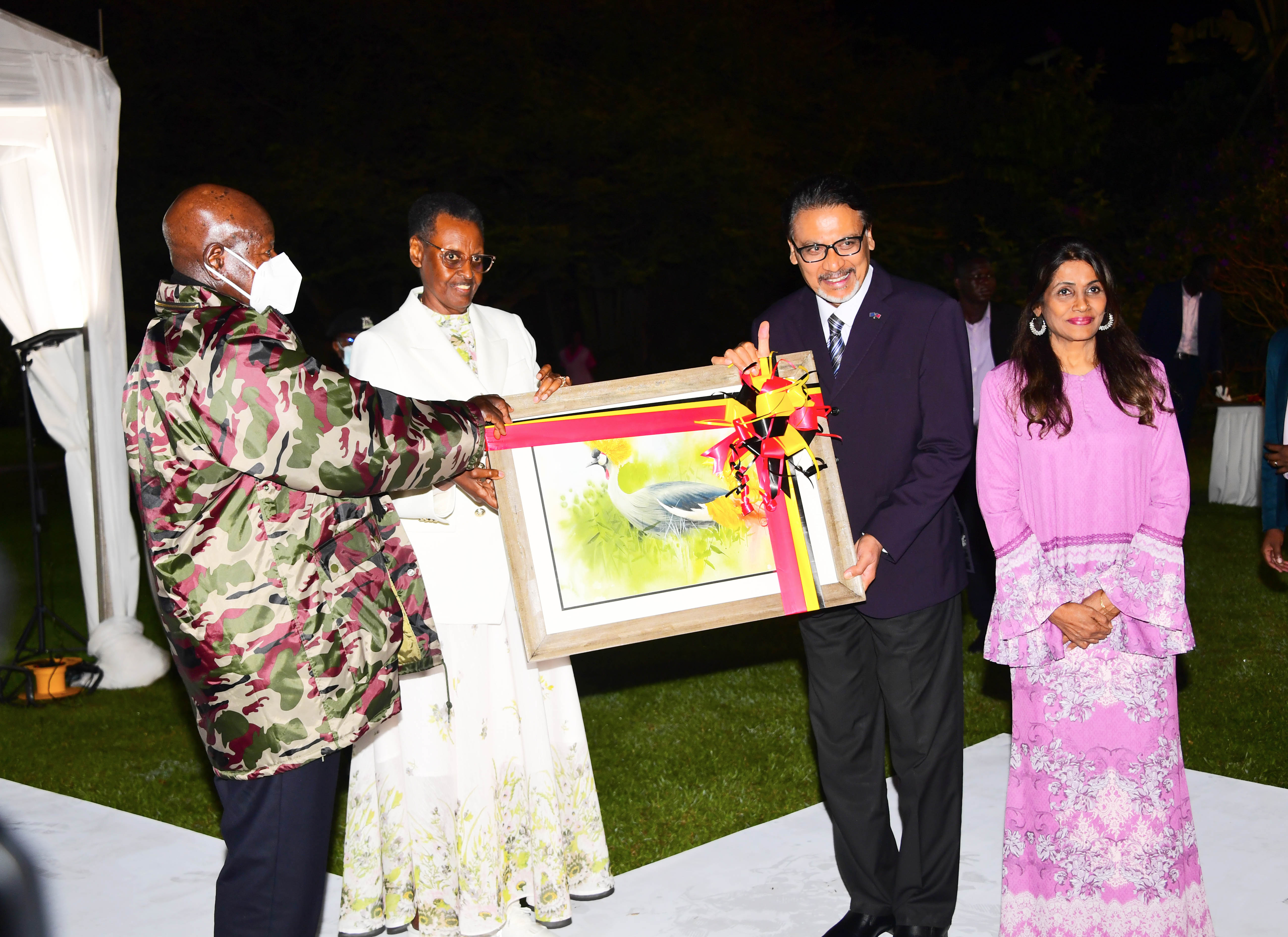
Despite making up less than one per cent of Uganda’s population, the Indian Community, according to reports from the Ministry of Finance, Planning and Economic Development, contributes at least 65 per cent of the nation's income tax revenue. This contribution was the basis for President Yoweri Kaguta Museveni’s speech, in which he commended the Indian Community for shielding Uganda’s economy through investment in industry and services. President Museveni made the remarks at State House, Entebbe during the Diwali, also known as the Festival of Lights, celebrations on Sunday, 26th October, 2025. “The economy is growing on account of your entrepreneurial capacities. By investing in factories and services, you are helping us to create a middle and skilled working class and revenue base for the government from which we can get money to educate Ugandans so that through business and education, we can create a modern society. I therefore appreciate what you are doing,” President Museveni said. He thanked the Indian Community for restoring their trust in Uganda despite initial setbacks climaxed by the 1972 economic war orchestrated by Idi Amin Dada that saw at least 80,000 Indians expelled from Uganda. “I went to an Indian temple in London and found some Indians there who were lamenting about Amin’s actions. I told them that Amin did more damage to Africans than Indians; he damaged our economy and killed several people. I am therefore very glad that you came back when we called you, thank you for trusting Uganda again,” he added. By 1972, Uganda had a population of 80,000 Indians with property totaling to 40,000. Today, the Indian Community is estimated to have about 40,000 members, many of whom are rooted in enterprises that support production, supply chains and employment across the country. The Indian High Commissioner to Uganda, H.E Singh Rawat expressed gratitude to President Museveni for his public acknowledgement of the Indian community’s substantial contribution to Uganda’s socio-economic development. “We welcome your continued encouragement for investment in value-addition and manufacturing. We also commend the steps taken under your administration to restore property rights and welcome back members of the diaspora who have revived economic activity,” H.E. Rawat noted. The Minister for Presidency, Hon. Babirye Milly Babalanda, also commended the Indian community for “shielding our economy and President Museveni for enabling the environment.” She called for more Indian investors in Uganda. “We should use this year's Diwali to attract other strategic friends to join you in investing in Uganda.” Mr. Paresh Mehta, the chairman of the Indian Association of Uganda, concurred with President Museveni that the expulsion of Asians was more painful to Ugandans than it was for Asians themselves. “Uganda lost a part of its productive and enterprising spirit, but it is the same land, the same people, only the vision has changed. But under your Excellency’s leadership, the vision has transformed Uganda into a country of opportunity and progress.” An example of Indian families, Ruparelias, Madhvanis and Mehtas stand as pillars of Uganda’s industrial and social progress. Sudhir Ruparelia specifically arrived in Uganda with 25,000 USD (Shs86m) but through an opportunity under the NRM government, he has managed to build a business empire worth USD 1.6bn. On an international level, Uganda and India share deep historical ties that have matured into broad engagement across trade, investment, development cooperation, technology transfer and defence cooperation. Accordingly, bilateral trade between the two countries has crossed the $1.2 billion USD mark. From a humanitarian perspective, so far, the Indian community has sent 238 children to India for life-saving heart surgeries along with their caretakers, and another 100 children will be sent next year. The community has also collectively donated 65,000 units of blood through their ongoing drives to celebrate Diwali, including the most recent at Singo Military Training School in Nakaseke and at the Sai Centre on Mawanda Road in Kampala. This is the 8th Diwali Dinner being hosted by President Museveni since 2013.

img
26 October 2025

PRESIDENT MUSEVENI TO CATHOLICS: WORK HARD TO SUPPORT THE CHURCH, STATE AND YOUR FAMILIES

President Yoweri Kaguta Museveni has today challenged congregants at St. Mary’s Cathedral Lubaga to take seriously the examples from the parable of talents and St Paul’s Thessalonians message on hard work, provision and community support. “I call upon you all to concentrate more on the parable of talents and the message of St Paul; whoever does not work, will not eat. My challenge to you, therefore, is to work so you get out of poverty, that you may support the church, the state and your families; this is the message I and the NRM concur with. It is the best Christian Doctrine besides one that says love your neighbour as you love yourself.” President Museveni made the remarks during the Cathedral’s Centenary Celebrations at Lubaga hill, Kampala. The event attracted over 5,000 worshipers, preceded by a Holy Mass at 10:00 am, led by Kampala’s Archbishop Paul Ssemogerere. Also present were government dignitaries led by the Prime Minister, Rt. Hon. Robinah Nabbanja, as well as top brass from the Mengo kingdom led by the Premier, Owek. Charles Peter Mayiga. Also present were the Apostolic Nuncio, Archbishop Augustine Kasujja and all the Bishops of the Kampala Archdiocese. The President, also while using the parable of the good Samaritan, called for unity among Ugandans, urging that the NRM’s message is premised on the pillar of interest rather than identity. According to the Parable of the Good Samaritan, a man was robbed, beaten and left for dead; he was not helped by a priest and Levite but by another passerby, a samaritan who was a member of a disliked group by the jews. “We shall know them by their fruits,” President Museveni quoted, adding that, “In the NRM, we do not care about who but what the person has done. Just like the bible says, let your light shine before men, that they may see your works and glorify the Father who is in heaven. We therefore need to be real Christians guided by this parable.” Speaking at the same event, Archbishop Ssemogerere thanked the President for continuously standing in solidarity with the church, urging that it is a testimony that faith remains a “pillar in building our nation”. “We thank you for the collaborations in education and health. Many of our schools and hospitals continue to save lives and serve our people because of the environment your government provides. We also thank you for honouring this occasion and recognising the role of the church,” the Archbishop said. He prayed for the nation for peace to prevail in the election season, and called upon the youth to use their energy to build rather than break the country. The Archbishop also cautioned leaders to inspire unity and love for God and the country. He appealed to the government to make swift interventions in the issues of land grabbing, which he says have plagued the country. “We draw your attention to concerns in our country regarding land grabbing. We appeal to your continued leadership and interventions so that this issue can be addressed firmly and justly,” he said. The Cathedral was constructed in 1925 through a community effort, 48 years following the arrival of the Catholic Missionaries. Bishop Henri Streicher and Brother Cyprian oversaw the work, including training local craftsmen at a skilling centre in Kasubi. The land on which the Cathedral was built was a generous offer from Kabaka Mwanga II to French Catholic Missionaries, also known as White Fathers. It was originally hosting a palace belonging to Kabaka Mutesa I but was abandoned after fires razed the place. Towering on 24 pillars, the religious marvel put together by over 2.5 million locally made bricks also has a historic relevance, having hosted the African Bishops Synod in 1969.