img
23 October 2025

PRESIDENT MUSEVENI HIGHLIGHTS CRITICAL ROLE OF PEACE IN ACHIEVING REGIONAL PROGRESS

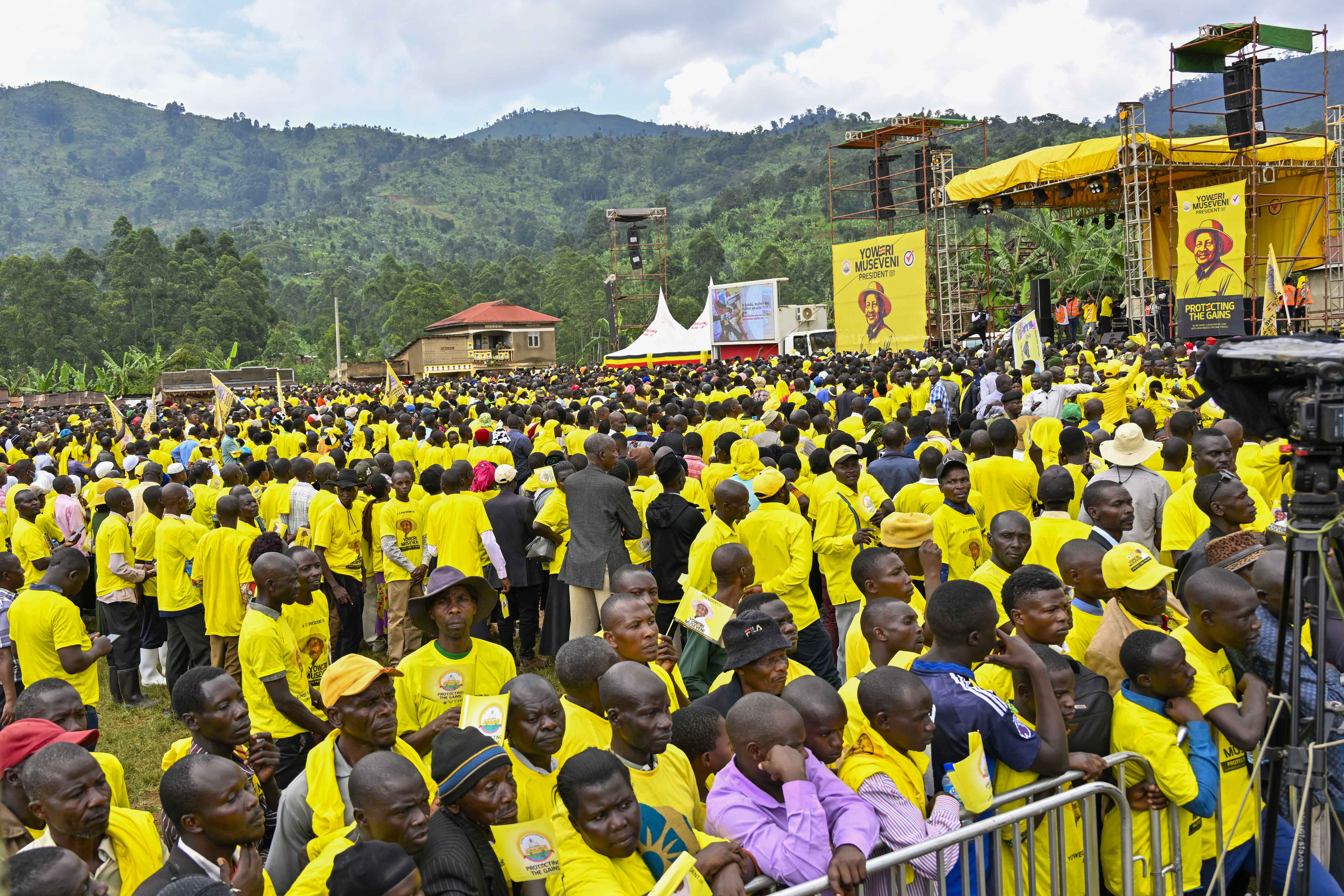
Thousands of jubilant supporters thronged Kaunda Grounds in Gulu City today to welcome President Yoweri Kaguta Museveni, the National Resistance Movement (NRM) presidential flag bearer, as he addressed the people of Gulu and the wider Acholi sub-region. With the air buzzing with excitement and banners waving in support of NRM, President Museveni opened his address with a heartfelt greeting. Reflecting on Uganda’s past, President Museveni highlighted the critical role of peace in achieving regional progress. “Uganda was at war for a long time but now NRM has been able to achieve peace, supported by you. It was not accidental that we achieved this peace; it’s because of the unity of politics and building strong national institutions like the army,” he said. On development, the President emphasized the government’s commitment to both economic and social infrastructure. “As NRM, we have worked on development; the economic infrastructure at least road—you know the road from Kampala to Gulu, which we have done several times, the road from Karuma to West Nile, the road from Olwiyo all the way to Kitgum and beyond, and Gulu to Nimule. We are also going to work on the roads connecting Awere-Corner Kilak to Patongo.” He added that investments in electricity, telephones, piped water, and railways are all part of the broader economic infrastructure, while social infrastructure includes schools and health facilities. The President stressed the importance of modern approaches to wealth creation. “Our people work a lot but in the traditional way and they get little because they do things which are outdated. We must get out of poverty by listening to our programs of utilizing small land and differentiating between development and wealth.” He outlined government programs designed to lift people out of poverty: “In the next government, since you are supporting NRM, we are going to ensure that this program of wealth creation continues. All the money we have been spending like NAADS, OWC, Entandikwa , was to help you get out of poverty. We are going to continue those programs.” On practical initiatives, the President highlighted agriculture, fish farming, and livestock restocking. “In the coming government, we are going to emphasize fish farming at the edge of the swamps, instead of putting it in the center. That water can be used for irrigation,” he said. “Now, as part of wealth creation, the areas of Teso, Lango and Acholi had cows, but they were destroyed by wars and cattle rustling. When peace returned, we tried to restock, and we directed that each homestead receives five cows. Some had rejected the idea, but I am glad that it has been agreed on, and we are taking that position, so that compensation of the five cows per household has been agreed on.” President Museveni also addressed the issue of employment, cautioning against the misconception that jobs are only government positions. “When people talk about jobs, jobs come from wealth. If we don’t create wealth, you can’t create jobs. Some people only think about government jobs. This is misleading. Government jobs are very few altogether, about 480,000. But these factory jobs alone are now employing 1.3 million people, almost three times the number working for the government. He also referenced regional integration as key to sustaining industries. “As we speak today, Uganda produces more than 5 million tonnes of maize per year, yet within a year, Uganda consumes only 1 million tonnes, leaving a surplus of 4 million tonnes. If we did not have the East African market, the maize industry would collapse. The same applies to milk, bananas, beer, cement, and many other products. This is why NRM emphasizes regional integration for economic purposes,” he noted. The Gulu City NRM Chairperson, Gifter Aber, welcomed the President and praised NRM’s record in the region. “We appreciate Your Excellency for giving us women opportunities to contest and empower women. Thank you for accepting the free education policy in the region. We thank you for supporting party structures from the village to district levels, and for your peaceful leadership in the region,” she said. Ms. Aber emphasized that these achievements have directly impacted Gulu’s social and economic landscape. “The city now boasts of the University of Gulu, a milestone for higher education access in northern Uganda, alongside the Gulu Cancer Institute, ensuring patients no longer need to travel to Kampala for specialized care.” She also highlighted the Presidential Skilling Hub, a resource for vocational training that equips young people with practical skills to enter the workforce. “The modern market constructed for our people in Gulu City has transformed local trade, while the expansion of health centers and government schools ensures that our citizens receive essential services,” Aber noted. Her remarks were supported by figures showing significant progress in various development programs. The Parish Development Model (PDM) has made a notable impact, with Gulu District receiving Shs 14.4bn, disbursed to 14,143 households, while Gulu City received Shs 9.8bn, benefiting 9,792 households. In addition, all three constituencies of Gulu District and City have a total of 54 Emyooga SACCOs, supporting 41,576 members, with the government disbursing Shs 2.1bn to facilitate community savings and business ventures. Education has seen remarkable improvements. Gulu District has 47 government primary schools and 5 government secondary schools, while Gulu City has 41 government primary schools and 7 government secondary schools, all providing Universal Secondary Education and post-ordinary level training. Healthcare infrastructure has also expanded, with Gulu Regional Referral Hospital now equipped with an ICU, CT scan, X-ray and ultrasound services, two functional oxygen plants, and ambulances, while district health centers continue to be upgraded to provide better services for local communities. Ms. Aber concluded by highlighting access to clean water and irrigation initiatives that support farmers; 87% of villages in Gulu District now have safe water, and multiple small-scale and solar-powered irrigation schemes are advancing climate-resilient agriculture. Through these achievements, Ms. Aber emphasized, the NRM government has laid the foundation for continued peace, development, and wealth creation in Gulu and the broader Acholi sub-region. The campaign is running under the theme: “Protecting the Gains, Making a Qualitative Leap into High Middle-Income Status”. The event was graced by NRM Central Executive Committee (CEC) members, Members of Parliament, religious and cultural leaders, as well as thousands of supporters.

img
22 October 2025

PRESIDENT MUSEVENI HIGHLIGHTS CRITICAL ROLE OF PEACE IN ACHIEVING REGIONAL PROGRESS

Thousands of jubilant supporters thronged Kaunda Grounds in Gulu City today to welcome President Yoweri Kaguta Museveni, the National Resistance Movement (NRM) presidential flag bearer, as he addressed the people of Gulu and the wider Acholi sub-region. With the air buzzing with excitement and banners waving in support of NRM, President Museveni opened his address with a heartfelt greeting. Reflecting on Uganda’s past, President Museveni highlighted the critical role of peace in achieving regional progress. “Uganda was at war for a long time but now NRM has been able to achieve peace, supported by you. It was not accidental that we achieved this peace; it’s because of the unity of politics and building strong national institutions like the army,” he said. On development, the President emphasized the government’s commitment to both economic and social infrastructure. “As NRM, we have worked on development; the economic infrastructure at least road—you know the road from Kampala to Gulu, which we have done several times, the road from Karuma to West Nile, the road from Olwiyo all the way to Kitgum and beyond, and Gulu to Nimule. We are also going to work on the roads connecting Awere-Corner Kilak to Patongo.” He added that investments in electricity, telephones, piped water, and railways are all part of the broader economic infrastructure, while social infrastructure includes schools and health facilities. The President stressed the importance of modern approaches to wealth creation. “Our people work a lot but in the traditional way and they get little because they do things which are outdated. We must get out of poverty by listening to our programs of utilizing small land and differentiating between development and wealth.” He outlined government programs designed to lift people out of poverty: “In the next government, since you are supporting NRM, we are going to ensure that this program of wealth creation continues. All the money we have been spending like NAADS, OWC, Entandikwa , was to help you get out of poverty. We are going to continue those programs.” On practical initiatives, the President highlighted agriculture, fish farming, and livestock restocking. “In the coming government, we are going to emphasize fish farming at the edge of the swamps, instead of putting it in the center. That water can be used for irrigation,” he said. “Now, as part of wealth creation, the areas of Teso, Lango and Acholi had cows, but they were destroyed by wars and cattle rustling. When peace returned, we tried to restock, and we directed that each homestead receives five cows. Some had rejected the idea, but I am glad that it has been agreed on, and we are taking that position, so that compensation of the five cows per household has been agreed on.” President Museveni also addressed the issue of employment, cautioning against the misconception that jobs are only government positions. “When people talk about jobs, jobs come from wealth. If we don’t create wealth, you can’t create jobs. Some people only think about government jobs. This is misleading. Government jobs are very few altogether, about 480,000. But these factory jobs alone are now employing 1.3 million people, almost three times the number working for the government. He also referenced regional integration as key to sustaining industries. “As we speak today, Uganda produces more than 5 million tonnes of maize per year, yet within a year, Uganda consumes only 1 million tonnes, leaving a surplus of 4 million tonnes. If we did not have the East African market, the maize industry would collapse. The same applies to milk, bananas, beer, cement, and many other products. This is why NRM emphasizes regional integration for economic purposes,” he noted. The Gulu City NRM Chairperson, Gifter Aber, welcomed the President and praised NRM’s record in the region. “We appreciate Your Excellency for giving us women opportunities to contest and empower women. Thank you for accepting the free education policy in the region. We thank you for supporting party structures from the village to district levels, and for your peaceful leadership in the region,” she said. Ms. Aber emphasized that these achievements have directly impacted Gulu’s social and economic landscape. “The city now boasts of the University of Gulu, a milestone for higher education access in northern Uganda, alongside the Gulu Cancer Institute, ensuring patients no longer need to travel to Kampala for specialized care.” She also highlighted the Presidential Skilling Hub, a resource for vocational training that equips young people with practical skills to enter the workforce. “The modern market constructed for our people in Gulu City has transformed local trade, while the expansion of health centers and government schools ensures that our citizens receive essential services,” Aber noted. Her remarks were supported by figures showing significant progress in various development programs. The Parish Development Model (PDM) has made a notable impact, with Gulu District receiving Shs 14.4bn, disbursed to 14,143 households, while Gulu City received Shs 9.8bn, benefiting 9,792 households. In addition, all three constituencies of Gulu District and City have a total of 54 Emyooga SACCOs, supporting 41,576 members, with the government disbursing Shs 2.1bn to facilitate community savings and business ventures. Education has seen remarkable improvements. Gulu District has 47 government primary schools and 5 government secondary schools, while Gulu City has 41 government primary schools and 7 government secondary schools, all providing Universal Secondary Education and post-ordinary level training. Healthcare infrastructure has also expanded, with Gulu Regional Referral Hospital now equipped with an ICU, CT scan, X-ray and ultrasound services, two functional oxygen plants, and ambulances, while district health centers continue to be upgraded to provide better services for local communities. Ms. Aber concluded by highlighting access to clean water and irrigation initiatives that support farmers; 87% of villages in Gulu District now have safe water, and multiple small-scale and solar-powered irrigation schemes are advancing climate-resilient agriculture. Through these achievements, Ms. Aber emphasized, the NRM government has laid the foundation for continued peace, development, and wealth creation in Gulu and the broader Acholi sub-region. The campaign is running under the theme: “Protecting the Gains, Making a Qualitative Leap into High Middle-Income Status”. The event was graced by NRM Central Executive Committee (CEC) members, Members of Parliament, religious and cultural leaders, as well as thousands of supporters.

img
22 October 2025

PRESIDENT MUSEVENI PLEDGES MORE DEVELOPMENT PROJECTS IN LAMWO

President Yoweri Kaguta Museveni has today assured the people of Lamwo District of continued government investment in infrastructure, education, and wealth creation programs to lift households out of poverty and consolidate peace in Northern Uganda. Addressing a campaign rally at Padibe Boys Primary School in Padibe Town Council, Lamwo District, the President began his remarks by condoling with families affected by the recent accident in Kiryandongo. “First of all, I want to condole with the people who got into an accident in Kiryandongo. I am very sorry about that. I have already directed the State House Comptroller to give each family that lost a person five million shillings, and one million shillings to those who were injured. But please, drive carefully,” he said. President Museveni, who is also the NRM National Chairman and party Presidential flagbearer, reminded supporters that the ruling party’s achievements and future plans are clearly outlined in its seven-point manifesto. He emphasized that peace remains the foundation of all progress, describing it as one of the NRM’s greatest achievements. “You people of Lamwo are witnesses to what peace means. This is the first time in 500 years that Uganda has enjoyed peace. The NRM ended wars between tribes, kings, and cattle rustlers. When you are looking for the party that can lead the country, it is the NRM,” he said. The President also highlighted the government’s investment in both economic and social infrastructure, noting that Lamwo District has greatly benefited from these initiatives. He revealed that Lamwo now has 74 government primary schools and seven government secondary schools, which he said was remarkable progress for a border district. “When I came here and found seven government secondary schools in Lamwo, I was very happy. Our plan is to have a primary school in every parish and a secondary school in every sub-county. Those that don’t have yet will be covered,” he said. On health, President Museveni said the steady population growth in Lamwo — now above 200,000 — is proof that government health interventions are working. “Children are no longer dying from preventable diseases, which shows that our health programs are effective,” he noted. He also expressed satisfaction with the progress made in providing electricity, water, and roads in the district. “When we came into government, electricity was stopping in Lira. We have since extended it through Kilak all the way to Lamwo. There are 530 villages in Lamwo and 432 of them now have water — that is 82 percent coverage. The remaining 92 villages will also be worked on,” he assured. On wealth creation, the President urged residents to make full use of government programs such as the Parish Development Model (PDM), NAADS, Emyooga, and Entandikwa to transform their livelihoods. “Use the chance of PDM to get out of poverty. Each parish will continue to receive 100 million shillings every year. We are also adding 15 million shillings for leaders. There will also be special funds for religious and cultural leaders, university graduates who are unemployed, and even Boda Boda riders,” he said. He reiterated the NRM’s gradual and prioritized approach to development, noting that infrastructure must come first to enable broader economic transformation. “We, the bush fighters, believe in prioritization — step by step. Some people want salary increases before roads and electricity are done, but we cannot scatter our resources. Roads, electricity, and peace are the foundation of all progress,” he explained. President Museveni added that Uganda’s oil, discovered under NRM leadership, will further boost the country’s economic capacity when production begins next year. During the same rally, Lamwo District NRM Chairman, Mr. Odoki Pollycap commended President Museveni for his visionary leadership and the peace ushered in by the NRM government. He also presented several local requests on behalf of the district. “We thank you, Your Excellency, for your able leadership which has brought development and stability to our region. We request the government to consider granting Palabek district status, establish a skilling hub in Lamwo, and upgrade Padibe Health Centre IV into a district hospital,” Mr. Odoki said. The President promised to follow up on the requests and called on Lamwo residents to remain steadfast in their support for the NRM, saying that together, they will achieve full socio-economic transformation. “You have seen what we have done. Let us continue working together — Lamwo will never be the same again,” he concluded.

img
21 October 2025

PRESIDENT MUSEVENI HAILS PEACE RESTORATION AND PROGRESS IN ACHOLI SUB-REGION

For decades, residents of Nwoya and the Acholi sub-region lived under the shadow of war and displacement. Today, thanks to the National Resistance Movement (NRM) government policies, peace is now being enjoyed in the region. President Yoweri Kaguta Museveni, who is also the NRM Presidential Flag bearer, recounted this journey today during a campaign rally at Anaka Primary School playground where he addressed thousands of supporters. The campaign is running under the theme: “Protecting the Gains, Making a Qualitative Leap into High Middle-Income Status”. “You people, why are you here? Why don’t you cross the Nile and go to the other side?” President Museveni asked, recalling his first visit to Anaka when many families were living in IDP (Internally Displaced Persons) camps. “Even the people on the other side were saying, ‘Museveni is bringing Kony here.’ I explained that Kony was just one person; the majority of Ugandans were not against peace,” he said. “A few years later, I found a big town called Bweyale, populated by the very people I had encouraged to leave the camps. They had gone, settled, and enjoyed peace until their areas were safe again. That is how the NRM has been able to bring and maintain peace in Uganda.” President Museveni emphasized that peace is the foundation for all development. “After peace, we focus on development, which has two parts: economic infrastructure and social infrastructure,” he said. He highlighted the economic progress in Nwoya, noting the construction of tarmac roads connecting towns, repair of the railway up to Gulu and Pakwach, expansion of electricity networks, and widespread access to telephones. On social infrastructure, he said, “There are now many government and private schools and health facilities across the district. In 1991, Nwoya’s population was small, and many children were dying from preventable diseases. The NRM said no more children dying. That is our second great achievement, peace and development.” Despite these achievements, the President warned that poverty remains a personal challenge. “Do not be diverted by the roads, electricity, and other public infrastructure. Those are collective assets, they belong to all of us but poverty is personal, and wealth is also personal,” he said. President Museveni urged residents to utilize government programs that support economic empowerment. “From the 1960s, some of us in the NRM have been campaigning for wealth for everybody. Over the years, we have sent money to help you create wealth, through Entandikwa, NAADS, Operation Wealth Creation (OWC), and more recently Emyooga and the Parish Development Model (PDM). Please use these opportunities well. They are not for the rich; they are for ordinary Ugandans ready to work and improve their livelihoods,” he emphasized. On education, President Museveni stressed the importance of free education in government schools. “Those who don’t support my policy of free education are creating a time bomb, conserving ignorance, and destroying the future of our children along with their potential. You have seen in just six months in the Presidential Skilling Hubs what these children are producing,” he said. “Some of these policymakers will even deny themselves a place in heaven, because when a child says, ‘My parents died, but I want to go to school’. Who will take responsibility? Uganda is one big family. If a parent dies, the family of Uganda, through its government, must take care of those children. That is what the NRM stands for. Let us stop this wastage of human resources. These children are our greatest wealth.” He also committed to further improve health infrastructure. “On health, you want us to upgrade Health Center III facilities, and we shall ensure that happens.” President Museveni concluded the rally by urging the people of Nwoya to embrace both collective infrastructure and personal initiatives to improve their livelihoods. “Peace has been restored, development is ongoing, but wealth is personal. It is up to each of you to use the opportunities the government provides and transform your lives,” he said. Hon. Hamson Denis Obua, NRM Vice Chairperson for Northern Uganda, lauded the President’s impact in Nwoya and the Acholi region. “The history of Nwoya and Acholi is well documented. People come in big numbers to listen to your message as the NRM flag bearer, but they also come to thank you for delivering them from the difficult times. Apart from restoring peace, you have championed development. You are the alpha and omega of ensuring that this region progresses,” he said. Ms. Mego Adokorach, the NRM District Chairperson, added that programs such as the Parish Development Model, Emyooga, and skilling hubs have empowered youth and women. “Your Excellency, we want you to come and see these activities firsthand. Visiting these farmers and witnessing the results will encourage us even more,” she said. NRM Initiatives and Impact in Nwoya: According to the Nwoya fact sheet, government programs have reached thousands of households in Nwoya. Under the Parish Development Model, 13,343 households have received Shs.13.34 billion out of 53,086 households in the district. Emyooga SACCOs support 13,405 members across 32 groups, with Shs.1.38bn disbursed so far. In the education sector, Nwoya hosts 44 government primary schools and 12 private schools, along with six government secondary schools providing Universal Secondary Education and Post O-Level Education. Three seed secondary schools are under construction, reducing gaps in secondary education coverage. Health infrastructure includes; one general hospital and seven Health Center IIIs, with additional HCIII construction and upgrades ongoing. Water coverage has reached 81% of villages, with piped water and sanitation systems in major towns including Purongo, Nwoya, and Anaka. Irrigation schemes are supporting crop production, including the Lutuk and Tangi systems, as well as solar-powered projects at Lapem and Got Okwara. Major road projects such as Gulu-Atiak, Olwiyo-Gulu, and Acholibur-Musingo have been completed, improving connectivity across the district. The event was graced by NRM Central Executive Committee (CEC) members, Members of Parliament, religious and cultural leaders, as well as thousands of supporters.

img
20 October 2025

COMMEMORATION OF THE INTERNATIONAL DAY OF LITTLE PERSONS ON 25th October, 2025

THE REPUBLIC OF UGANDA PRESS STATEMENT ON THE COMMEMORATION OF THE INTERNATIONAL DAY OF LITTLE PERSONS ON 25th October, 2025 BY HON ASAMO HELLEN GRACE (MP) MINISTER OF STATE FOR DISABILITY AFFAIRS MINISTRY OF GENDER, LABOUR AND SOCIAL DEVELOPMENT Members of Parliament for Persons with Disabilities Representatives of Organisation of Persons with Disabilities The Distinguished Members of the Media Fellow Country Women and Men 1.1I am delighted to address you today on the forth coming commemoration of the International Day of Little Persons under the theme: “Raising Awareness about Dwarfism and Promoting Inclusion of Little Persons in Uganda”. 1.2Every year on October 25, International Dwarfism Awareness Day celebrates little persons. The day is used to create awareness for achondroplasia, a bone growth disorder that causes dwarfism. 1.3Achondroplasia means “without cartilage formation.” It occurs in one in every 15,000 to one in 40,000 live births. According to the Uganda National Housing and Population statistics (2024), there are over 194,271 with 89,102 males and 105,169 females’ persons aged 18 and above who are Little Persons. Those who have this condition are called Little Persons. Other preferred ways to refer to those with achondroplasia include Little People or Persons with Short Stature or Persons Affected by Dwarfism. 1.4Dwarfism is characterized by having short arms and legs in comparison to the head and trunk. Weak muscle tone, sleep apnea (sleep disorder causing irregular breathing and snoring patterns, leading to severe exhaustion and various health risks), and spinal stenosis (happens when the space inside the backbone is too small) are also sometimes present. The average height of men with dwarfism is 4 feet, 4 inches. The average height of women with dwarfism is 4 feet, 1 inch. Most persons with dwarfism have a final height of 4 feet 10 inches or less. 1.5While some Little People still face physical and social barriers, many go on to lead fulfilling and active lives. Many with dwarfism drive, complete their education, get married, and even have children of their own. There are also many famous people with dwarfism. These famous people include actors, entertainers, comedians, musicians, athletes, and politicians. Who knows ‘Sarah short’ Why commemorate the Day 1.6This day is used to create awareness on the importance of promoting equality and full participation of Little Persons in social life as well as development. 1.7Commemorating the International Day for Little Persons provides a vital platform to amplify their voices and recognize their capacities and contributions. 1.8The primary objective of this day is to enhance public understanding of dwarfism its causes, characteristics, and management while dispelling myths and reducing stigma. Increasing awareness fosters a culture of respect and dignity toward persons of short stature. 1.9Equally important is the call to promote their full inclusion in all aspects of society. This entails ensuring equal access to education, healthcare, employment, and social services by eliminating the social, physical, and systemic barriers that hinder their participation. Upholding inclusion affirms their right to live with dignity, to contribute meaningfully to national development, and to enjoy all fundamental human rights. 1.10Through this commemoration, we reaffirm Uganda’s commitment to building an inclusive society, where all persons with disabilities including Little Persons are valued, empowered, and fully integrated as equal members. It is only through sustained awareness and deliberate inclusion that we can advance their welfare and uphold their rights in our nation. 1.11 I want to remind Ugandans that Schedule 3 of the Persons with Disabilities Act (2020) provides for 8 disability categories or impairments. These include the following: Physical Disability Hearing disability Visual disability Deaf and blind disability. Mental disability Little people. Albinism. Multiple disabilities What Government has done 1.12The Government of Uganda is committed to fostering an enabling environment for Little Persons through inclusive policies and programs that guarantee equal access to education, healthcare, and economic opportunities. 1.13Our legal frameworks, including the Constitution and the Persons with Disabilities Act 2020, uphold the rights of persons with disabilities and mandate stakeholders to provide specialized support where needed. 1.14The Revised National Policy on Persons with Disabilities prioritizes protection against discrimination and neglect, while promoting improved communication, healthcare access, and social inclusion tailored to individual needs. Since ratifying the UN Convention on the Rights of Persons with Disabilities in 2008, Uganda continues to uphold full participation and non-discrimination of little persons 1.15In education, the Government has implemented affirmative action to increase enrollment and retention of children and youth affected by short stature in both mainstream and special education settings, facilitating access to tertiary institutions. The Ministry of Health provides specialized services, including early diagnosis and targeted care, to improve well-being. 1.16Economic empowerment programs, such as the National Special Grant and the Parish Development Model with its 10% allocation for disability-inclusive initiatives, ensure that Little Persons benefit from livelihood opportunities. Government has already set aside 50million shilling as myoga SACCO for Little Person at national level. 1.17Partnerships with organizations like the Foundation of Persons Affected by Dwarfism (FPAD) have been crucial in raising awareness, combating stigma, and building capacity to promote social inclusion. The Government is also strengthening data collection and research to inform evidence-based policies and services. 1.18We remain dedicated to increasing the involvement of Little Persons in policy development and program design, ensuring their voices guide decisions that affect them. Through continued collaboration with stakeholders, the Government will enhance public awareness and service delivery to eliminate barriers, uphold dignity, and advance the full inclusion of Little persons in Uganda’s development. 1.19 Fellow countrymen, though there have been several achievements as highlighted above, the following areas need more emphasis: (i)Scale up mobilization for Little Persons to enhance access to PDM by Little Persons to ensure they join other persons with disabilities and take up the 10% PDM share and the National Disability Grant. (ii)Revive the orthopedic and other workshops in regional hospitals to facilitate affordability of rehabilitation services and assistive devices such as wheel chairs and clutches (iii)Step up the implementation of commitments to the Global Disability Summit, so that at the next reporting, our Country is not downgraded as non-compliant. (iv)Under NDP4, prioritise Disability inclusion across the 18 Programme areas to mitigate the previous low performance which was highlighted in NDP3 Mid-Term Review; 1.20 The National theme for this year’s celebration is: “Raising Awareness about Dwarfism and Promoting Inclusion of little persons in Uganda”. 1.21 The National theme emphasizes the importance of the need to educate the public, challenge misconceptions, and advocate for equal opportunities and rights for Persons of Short Stature in Uganda. 1.22Little Persons, often referred to as persons with short stature or persons affected by dwarfism, face a complex web of challenges that affect nearly every dimension of their lives physical, social, economic, psychological, and institutional. These challenges are not inherent to their stature, but arise largely from environments, systems, and attitudes that exclude people who do not conform to average physical norms. 1.23In Uganda, despite the protection afforded by the Persons with Disabilities Act (2020) and the Revised National Policy on Persons with Disabilities (2023), little persons continue to struggle with accessibility, recognition, and dignity in daily life. 1.24A major area of concern is the inaccessibility of the physical environment. Most of Uganda’s infrastructure for example buildings, roads, and public facilities have been designed without consideration for persons of short stature. 1.25Walkways and pavements, which could have been safe mobility spaces, are increasingly obstructed by barricades installed by city authorities to control boda boda riders. In Kampala and other urban areas, these barriers, though intended to prevent motorcycle lawlessness, have inadvertently restricted the mobility of Little Persons, particularly those using wheelchairs or walking aids. 1.26Public transport presents another barrier; taxis and minibuses often refuse to stop for Little Persons, or drivers express reluctance to carry them, assuming they will require excessive assistance or cause delay. This form of everyday discrimination undermines their independence and right to mobility. Health and medical challenges further compound their exclusion. 1.27Little persons frequently experience orthopedic, spinal, and joint conditions that require specialized attention, yet few health professionals in Uganda are trained to manage these. 1.28Cases of incorrect medication dosage both overdosing and under dosing are not uncommon, as health workers often prescribe based on standard adult height and weight. 1.29Women who are Little Persons face particularly high risks during childbirth, as delivery beds are typically high and not adapted for their stature, making normal delivery extremely difficult. 1.30Access to reproductive health services and contraceptives is equally problematic, as community health workers sometimes assume that women of short stature are minors or asexual and therefore ineligible for family planning. These assumptions reflect not only medical ignorance but also harmful stereotypes that undermine bodily autonomy and family planning choice. In the world of education; 1.31Learners with Little Persons are still marginalized by both the system and social attitudes. 1.32In many schools, classmates mock Little Persons by forcing them to “touch the opposite ear” over the head a humiliating act used to measure whether someone is “old enough” for school. Teachers rarely intervene, and some even share in the ridicule. 1.33Classroom settings are not adapted to their needs; desks are too high, blackboards are out of reach, and school notice boards are mounted far above their eye level, making it difficult to access information. Such environments communicate exclusion and reinforce the perception that Little Persons do not belong in mainstream education. Employment and workplace accessibility remain equally troubling; 1.34Many employers still hold misconceptions about the capabilities of Little Persons and fail to provide reasonable accommodation. For example, biometric attendance systems and fingerprint scanners are often installed too high, making them difficult or impossible for Little Persons to reach. 1.35Counters, filing cabinets, and Bank ATM machines are similarly elevated, compromising both convenience and security especially when a person has to share their personal identification number (PIN) with a bystander or sometimes security guards to complete a transaction. 1.36In salons, the lack of adjustable chairs makes it difficult for women of short stature to comfortably receive hairdressing services, a simple act that becomes a reminder of their exclusion from everyday social spaces. 1.37Although Ugandan law allows persons with Little Persons to drive and provides tax waivers on imported customized vehicles for persons with disabilities, implementation remains restrictive. Many driving schools refuse to admit Little Persons, arguing that they cannot be accommodated or trained effectively due to vehicle modification requirements. 1.38As a result, many who could drive safely are denied the opportunity to acquire licenses, perpetuating their dependence on others for mobility. 1.39Similarly, public infrastructure such as courts and offices often ignore their presence little persons report being almost suffocated in courtrooms due to poor seating arrangements or being overlooked entirely in proceedings. Social and cultural stigmas further intensify these challenges. 1.40In communities, little persons are often ridiculed, viewed as objects of entertainment, or treated as perpetual children. This negative attitude extends to religious spaces, some churches push adults with Little Persons into Sunday school classes, assuming they are children. Such treatment erodes dignity and reinforces harmful stereotypes that little persons are incapable of adult responsibilities. 1.41Moreover, cultural misconceptions associating Little Persons with curses or witchcraft continue to persist in rural Uganda, leading to social isolation and discrimination. Access to information and communication also remains a barrier; 1.42Many public notices, advertisements, and bulletin boards are placed high on walls, far above the sightline of Little Persons, excluding them from opportunities and updates that others easily access. While Uganda’s Building Control Act and Persons with Disabilities Act (2020) both emphasize accessibility, enforcement remains weak. Most buildings still lack reasonable accommodation features such as adjustable counters, appropriately sized doorways, or ramps suitable for users of short stature. 1.43Psychologically, the cumulative impact of these barriers and prejudices is profound. Constant exclusion, mockery, and rejection lead to low self-esteem, anxiety, and depression among Little Persons. Some withdraw from public life altogether, while others struggle to assert their rights in spaces that continue to treat them as lesser beings. The lack of peer support and professional counselling services for this group exacerbates their isolation, leaving many to navigate these challenges alone. 1.44As I conclude on the challenges faced by little persons in Uganda, its important to note that most of them are rooted in structural exclusion and social prejudice. From inaccessible public spaces and discriminatory service provision to harmful cultural attitudes and policy neglect, little persons face compounded barriers that violate their rights to equality, dignity, and participation. 1.45Addressing these issues requires an inclusive approach one that enforces existing accessibility laws, trains professionals across sectors, raises awareness to combat stigma, and ensures that persons with Little Persons are visible and active participants in Uganda’s social, economic, and political life. Only through such deliberate measures can Uganda fulfill its commitment to leaving no one behind. 1.46In line with Uganda’s strong affirmative action framework and the UN Convention on the Rights of Persons with Disabilities 2006, we are expected to establish effective access to general technical and vocational skilling, ensure that reasonable accommodation is provided to Persons with Disabilities at the workplace, protect the rights of Persons with Disabilities on an equal basis and promote vocational and professional rehabilitation, job retention and return to workplace programmes for Persons with Disabilities. 1.47 To ensure an improvement in household incomes for Persons with Disabilities, The Government of Uganda (GOU) Provides for anti-discrimination provisions in the Employment Act 2006 which was enacted in line with the state policies such as Article 32 of the Constitution of the Republic of Uganda allowing affirmative action for marginalized groups. Venue for the National Celebrations 1.48 The venue for this year’s national celebration will be held at Kampala School for the Disabled, Mengo, on October 25th, 2025. 1.49 The pre-event and D-Day activities include: Opening Ceremony with keynote speeches and cultural performances, Educational sessions on dwarfism/ little persons, management, and rights, Panel discussions on challenges and policy advocacy, Showcasing success stories and peer support activities, Art and cultural exhibitions promoting diversity, Interactive Q&A session dispelling myths about short stature, Media engagement to raise public awareness and Launch of an informative dwarfism fact booklet, among others. 1.50In conclusion, I call upon Government Ministries, Civil Society, the media, and the public to support initiatives that advance the rights and inclusion of little persons. Together, we can foster a society where everyone, regardless of stature, is valued and empowered. I say this; For God and my country Asamo Hellen Grace (MP) MINISTR OF STATE FOR DISABILITY AFFAIRS

img
20 October 2025

YOU SHOULD BE A TESTIMONY TO PRESIDENT MUSEVENI'S WEALTH CREATION VISION”- STATE HOUSE COMPTROLLER TELLS SKILLING HUB BENEFICIARIES

The State House Comptroller, Ms. Jane Barekye has implored beneficiaries of the Zonal Presidential Industrial Skilling Hubs to be a testimony to President Yoweri Kaguta Museveni’s wealth creation vision. According to Ms. Barekye, President Museveni has been coming up with various initiatives aimed at fighting youth unemployment and one of them is skilling. Through the 19 Presidential Industrial Skilling Hubs spread across the country, youth irrespective of their education backgrounds, are trained in various vocational skills for six months free of charge. But, after skilling, they face a challenge of no start-up capital to put their skills into good practice. This prompted President Museveni to extend a financial support of Shs8.8 billion to SACCOs under the Skilling hubs. Each SACCO received a total of Shs50 million. The initiative has transformed the lives of thousands of youth around the country. “You should be a testimony to the President’s vision of wealth creation,” she said. The State House Comptroller made the remarks today while leading a training session on proper fund management to SACCO members and leaders, commercial officers and district leaders at Bunyoro Zonal Presidential Industrial Skilling Hub in Masindi district. Ms. Barekye called upon the SACCO leaders to safeguard and manage the SACCO funds well so that they serve the intended purpose. “When the President was here in Masindi, he promised to equip you with skills after that he gets you capital to get your families out of poverty,” she said. She further advised the beneficiaries to use the funds productively by starting up businesses so that they fight poverty and transform their livelihoods. “Change your lives, work hard so that you can help your families and be testimonies of tomorrow,” Ms. Barekye said, urging leaders to be patriotic and disciplined so that they execute their mandate effectively. “We are going to give you guidelines and continue sensitizing you,” she noted. On his part, the Director of Presidential Projects and Industrial Hubs, Eng. Raymond Kamugisha emphasised that the SACCO funds are only meant to be used to enhance the skills acquired from the skilling hubs, and beneficiaries should not invest it into other ventures like agriculture. “Don’t use this money for agriculture or any other business, use it for only the skills you got from here,” he urged. He also encouraged the trainees to have business plans before getting the loans, noting that it will help them to invest well. Eng. Kamugisha further explained about the value-addition component which is among the four components of the Presidential Industrial Skilling hubs, which he said was designed to address challenges related to post-harvest handling and managing of agricultural produce in the regions especially maize for the case of Bunyoro. One of the beneficiaries of the Bunyoro skilling hub, Kabakonjo Grace who acquired skills in tailoring revealed that she earns Shs500,000 a month and she is able to pay school fees for her children. “Before coming to the hub, I didn't have any ideas but now I have a business and money. I thank President Museveni for this initiative,” she said. Another beneficiary, Owobusobozi Patience, a former trainee at Bunyoro Industrial skilling hub is now a professional hair dresser and can make profits of Shs80,000 weekly. “I thank President Museveni for this initiative, and I promise to boost my business after I have received the SACCO money,” she said.

img
20 October 2025

“WE ARE NOT AGAINST THE SALARIES OF PUBLIC SERVANTS,” SAYS PRESIDENT MUSEVENI AS HE CONCLUDES WEST NILE CAMPAIGN TRAIL

President Yoweri Kaguta Museveni has reaffirmed his government’s commitment to improving the welfare of public servants, including teachers, but emphasized that Uganda must first consolidate its development foundations before increasing salaries. Speaking at a mega campaign rally held at Paridi Stadium in Adjumani Town Council on Monday, October 20, 2025, the President, also the National Resistance Movement (NRM) Presidential flagbearer for the 2026 elections, concluded his West Nile sub-region campaign trail with a call for patience and focus on national priorities that sustain peace and shared growth. “We are not against the salaries of public servants, but first of all, peace, the roads, electricity, health, and schools—then we can add on other things,” he said. H.E. Museveni said that while calls for salary increments, especially from striking teachers, were understandable, national transformation could not be achieved through short-term demands. “You have been hearing the teachers striking, saying that they want more salary. But is it correct to pay public servants more money when the roads are not done? Is it fair?” he asked, drawing loud applause from supporters. The Adjumani rally marked the climax of President Museveni’s tour across the West Nile sub-region, where he traversed multiple districts to promote the NRM’s core campaign themes: peace, development, and wealth creation. Flanked by top NRM officials, the President used the rally to explain why government spending priorities have remained anchored in national infrastructure and social services, drawing from his own experience in the Uganda People’s Defence Forces (UPDF), whose officers, he said, endured years of low pay for the sake of national peace. “We in the UPDF have been fighting for no pay or low pay for the last 55 years because we could not demand a high salary from our mother, Uganda, when we knew that our mother did not have enough money,” H.E. Museveni said. “What sort of a child are you when you come to a mother demanding more money, well knowing she does not have enough? The money of Uganda is public; it is in the budget. So, we must agree that roads must be tarmacked, and the murram roads must be maintained because the road affects the public servant and everyone else,” he stressed, while pointing out specific road projects in poor condition, including the Pakele–Pabo road and the Adjumani–Obongi route, pledging government intervention. “The security road from Pakele to Pabo is in bad condition and must be worked on. The road from Adjumani to Obongi is also in bad condition but we have finished the road from Gulu to Atiak to Adjumani, and we are continuing,” the President said. He reminded supporters that before the NRM government came to power, the tarmac road network ended at Gulu, but has since been extended northwards to Atiak, Adjumani, Laropi, Moyo, Yumbe, and Koboko, opening up trade and security access to border areas. “Once we agree on the budgeting—what comes first—things will move,” he said. “If there’s extra, then we can do other things. But let’s do the minimum first: the roads, the electricity, the schools, and the hospitals.” Turning to the question of peace and national unity, the President described Uganda’s current stability as “a historic achievement unmatched in over a century.” “It’s the first time in 100 years that the whole of Uganda is peaceful. Some people talk as if Uganda did not exist until the British came, but these tribes were here thousands of years before them,” President Museveni said. He offered a brief history lesson, tracing Uganda’s long journey to peace and post-independence turmoil. “We had peace between 900 and 1400 AD under the Bacwezi dynasty. After that, there was chaos, wars among successor kingdoms like Buganda, Bunyoro, Ankole, and others until the British came. After independence, there were more wars: Muteesa and Obote in 1966, Idi Amin from 1971 to 1979, and the NRM–UPC war between 1981 and 1986,” he recounted. “Even after NRM took power, there were wars like those of Kony and ADF but because of our ideology of patriotism and Pan-Africanism, we defeated all of them.” President Museveni said NRM’s inclusive ideology of opposing the wrong and supporting the right, not tribes or religions, had united Uganda and built strong national institutions, from the army to the judiciary and police. “That’s why we can win elections nationally in the first round,” he said, adding that no single tribe or region could ever do that alone. Regarding development, President Museveni told the Adjumani crowd that Uganda’s growing population was itself evidence of social progress. “In 1969 and 1970, the whole of Madi, which includes Moyo, Adjumani, and Obongi, had only 90,000 people,” he said. “Now, Adjumani alone has 300,000. Why? Because of immunization. Children no longer die from preventable diseases.” He cited healthcare and education as two pillars of NRM’s social development agenda, while acknowledging persistent challenges such as drug theft in government facilities. “The one problem in health is the stealing of drugs. Our people are using computers, but I am also thinking of getting religiously inclined people to monitor for me this stealing of drugs in the 1,400 health centers,” President Museveni said. No child should leave school because of money: President Museveni reaffirmed his commitment to free education, saying that every sub-county without a secondary school and every parish without a primary school would be catered for in the next term. “Since 1996, I have been telling you about free education, but some people don’t listen and continue to charge money in schools. That’s why children drop out,” he said, highlighting his Presidential Skilling Hubs, designed to train school dropouts with practical skills. One such centre, the Olia Hub in Adjumani, which serves the Madi Zone. “I have already sent 50 million shillings to their SACCO per district for those who finished the six-month training,” President Museveni said. He also proposed new initiatives for unemployed university graduates, saying the government would create a fund to support them if they remain jobless for more than two years. President Museveni revisited his long-standing distinction between development-public goods such as roads and schools, and wealth, which is private and family-based. He urged Ugandans to embrace household income programs like the Parish Development Model (PDM), which he called the culmination of earlier poverty alleviation efforts including Entandikwa, NAADS, Operation Wealth Creation, Emyooga, and the Youth Livelihood Fund. “Each year, we shall bring 100 million shillings per parish. In five years, that’s 500 million. If you borrow one million and pay back with a small interest, that money will stay in your parish and grow. It will never go back to the government,” he said. He also proposed new leadership and faith-based support funds. “I’m proposing we add Shs 15 million for local parish leaders and start a fund for religious leaders, Muslims, and Christians, so they also engage in wealth creation.” Oil discovery: President Museveni also spoke of Uganda’s oil discovery as a milestone that would amplify development funding once production begins. “The British tried to find our oil from 1920 to 1956 because it was boiling in the Albertine Valley, but they failed. When NRM came, we discovered it, and it will start flowing next year,” he said, adding that the government had already achieved much without the oil money. The rally was attended by senior party leaders, ministers, and Members of Parliament from across West Nile and neighboring regions, including Gen. Moses Ali, the Second Deputy Prime Minister, and NRM Secretary General Rt. Hon. Richard Todwong, who echoed President Museveni’s message of hope and continuity and described the NRM presidential candidate as “a symbol of stability and progress”. “In President Museveni, we vote for hope. We vote for stability in our homes, for the future of our children, for good health, and for progress,” Rt. Hon. Todwong said. Hon. Hamson Obua, NRM Vice Chairperson for Northern Uganda, congratulated President Museveni for a successful tour and praised the massive turnout in Adjumani. “The Bible tells us of the ten lepers healed by Jesus, but only one came back to say thank you. The turnout today shows that West Nile has come to say thank you—for the peace and transformation you brought,” Hon. Obua said. He commended President Museveni for transforming Adjumani “from a district that once produced refugees to one that now hosts them peacefully.” Mr. Akuku Charles, NRM Chairperson for Adjumani District, pledged full support for the President’s re-election and requested more tractors to expand agricultural productivity. “Your Excellency, I wish to assure you that the people of Adjumani are fully behind you,” Akuku said. “We ask for more tractors to increase land under cultivation and improve our livelihoods.”

img
20 October 2025

“APPLY FOR LOANS WHEN YOU ARE READY TO INVEST RESPONSIBLY” - STATE HOUSE COMPTROLLER TIPS SKILLING HUB SACCO MEMBERS

The State House on Sunday 19th October 2025 continued to train the Presidential Industrial Skilling Hub SACCO leaders on the proper management of funds. Recently, President Yoweri Kaguta Museveni supported SACCOs under the Presidential Industrial Skilling Hubs with Shs8.8 billion, in order to empower the skilling hub beneficiaries with start-up capital. Each SACCO received Shs50 million. The training session was held at Acholi Presidential Industrial Skilling Hub in Gulu city. It brought together SACCO members and leaders, commercial officers and district leaders from Acholi, West Nile and Lango sub-regions. During the training, the State House Comptroller, Ms. Jane Barekye emphasized proper management of funds. “If the funds are well utilised, President Museveni has promised to add more money in your SACCOs,” she emphasised. Ms. Barekye also urged SACCO leaders to be hardworking and remain disciplined so that the President’s support benefits all members fairly. She further called on parents of the beneficiaries to guide them on how to use the money properly by focusing on productive work. “My advice to the parents is that you encourage these children to use the money to enhance their skills. They shouldn't divert the money to other unproductive things,” she said. Ms. Barekye advised the beneficiaries to apply for the loans only when they feel that they are ready to invest responsibly, saying preparation and planning is key to running a successful business. “First, have a plan for what you want to use the money for, don’t just get it. With no plan, this money will not do what it’s intended for,” she warned. Eng. Raymond Kamugisha, the Director of Presidential Projects and Industrial Hubs, encouraged the trainees to always work in unison, explaining that this will help them to develop easily. “We shall start to get bigger loans if you work together and have big projects,” he said. “You should share responsibility and keep in touch with each other so that we can easily follow up with you and if you get any challenges, always inform us,” he advised. In his concluding remarks, Eng. Kamugisha appealed to the Commercial Officers to give an opportunity to the beneficiaries so that they can register companies to get tenders from the local government. The training facilitators, Mr. Joseph Lutalo from the Ministry of Trade, Industry and Cooperatives and Mr. Abdallah Aziz Apat from Post Bank appealed to the trainees to always keep in touch and share ideas that could help their enterprises to thrive. Success stories from beneficiaries: Jacqueline Ayubu, a former student of the Acholi Presidential Industrial Skilling Hub revealed that she now owns a shoe making business and earns a profit of Shs50,000 daily. “Before, I was dealing in agricultural produce having dropped out of school and I was earning Shs5000 per day. I later heard of Acholi Skilling hub through a friend, and I applied. I did a course in shoe making that has changed my life,” she said. “I want to take this opportunity to thank President Museveni for this initiative because if it wasn’t him, I wouldn't be here. I also thank H.E the President for the Shs50 million support to our SACCO.” Onek Peter, another beneficiary of the skilling initiative, undertook a course in welding and metal fabrication at the Acholi Presidential Industrial Skilling Hub. He now owns a workshop at Layibi centre earning Shs500,000 a month and also trains other youth. “I want to thank President Museveni for this initiative and for the skills I gained from here. I dropped out of school because my parents could not afford school fees but because of this hub, I now work and train other youth in welding,” he said. Another impactful story was heard from Mwaka Emmanuel Edgar, a former trainee in tailoring at the Acholi Presidential Industrial skilling hub. He now owns a workshop in Kitgum town with two employees, paying Shs150,000 monthly each and he is able to save Shs600,000 monthly. “I want to thank President Museveni for this opportunity. It helped me to acquire skills and I'm now earning good money.” The training is part of a nationwide effort to equip SACCO members and leaders with financial management skills and ensure the sustainability of the government empowerment program.

img
18 October 2025

PRESIDENT MUSEVENI PLEDGES TO CLEAR OBONGI’S DEVELOPMENT DEBTS

President Yoweri Kaguta Museveni has pledged to settle what he called the government’s “two major debts” to Obongi District—electricity connection and road infrastructure, assuring residents that the long-standing challenges of isolation and underdevelopment will soon be history. Addressing thousands of National Resistance Movement (NRM) supporters at Lionga Grounds, Obongi on Friday 17, October, 2025, the President, who is also the party Presidential flagbearer, said the government has already secured funding to bring electricity to the district and begin tarmacking its key roads within the current financial year. “We have two debts with Obongi, and one is electricity. Money has been secured to bring electricity to Obongi. We are going to use a World Bank loan to do this,” President Museveni said. “They’re now doing procurement, looking for the right company to do the work. That debt is paid because the money is already there,” he added. The President noted that Obongi and Buvuma remain the only two districts in Uganda not connected to the national electricity grid, a situation he said would soon be corrected. According to President Museveni, the construction of the power line connecting Obongi will commence before the end of the current financial year, marking a turning point in the district’s energy access. He also listed key road projects earmarked for upgrading, including the 132-kilometre Noko–Obongi–Adjumani–Owafa–Lubala–Kurikiringa road, and another route linking Goli–Panyimur–Pakwach–Rhinocamp–Obongi, which he said would boost tourism along the Nile corridor. “All these roads will be worked on, and Obongi will no longer be isolated,” he declared. The pledge is part of a broader infrastructure push across the West Nile sub-region. The President highlighted ongoing or planned tarmacking projects such as the Manibe–Jule road, Nebbi–Goli–Paidha–Zombo–Vura road, and the Laropi–Moyo road. President Museveni used the occasion to reflect on Uganda’s infrastructure transformation under NRM leadership. “When the NRM came into government, the tarmac road ended at Karuma on that side and Gulu on this side. Now tarmac has reached Koboko and Oraba, and from Gulu to Atiak, Adjumani to Laropi, Moyo—soon we shall link Adjumani and Obongi to these roads,” he said. While pledging major road upgrades, President Museveni also criticized district authorities for failing to maintain existing murram roads despite the availability of government equipment. “Even if the road is not tarmacked, it should be maintained in good condition and passable. In the West Nile, we have two government stations in Arua and Moyo, with all the necessary road equipment—graders, rollers, bulldozers, tippers. You wonder why the roads remain impassable. If somebody is sleeping, I’m going to wake them up,” he said. The President also urged local leaders to take responsibility for regular road maintenance, saying neglect undermines government investment. President Museveni took the supporters back to the 1980s, recalling his early familiarity with Obongi’s challenges when the area was still part of Moyo and Adjumani districts. “When I came into the government, I was aware of the isolation of Obongi. It was part of the Moyo and Adjumani districts. Although their population was small, I said no, these people need their own corner. So, we gave you a district deliberately because of geography and isolation,” he said. Obongi District, officially created in 2019, now has a population of about 142,000 people, according to the 2024 census. President Museveni said his return was both to “remind residents of NRM’s past commitments” and to present the party’s new manifesto. The NRM Manifesto: Peace, Unity and National Strength The President told the supporters that the NRM’s 2026 manifesto is built on seven core pillars, but he focused on three—peace, development, and wealth creation. “The first one is peace,” H.E. Museveni emphasized, noting that despite wars in neighboring countries, Uganda remains an island of peace because NRM’s politics unite Ugandans without focusing on religion or tribe, but on what one can do for the country. He attributed stability to NRM’s deliberate effort to build inclusive national institutions like the army, police, and civil service that draw personnel from all regions of the country. “One of my commanders, the late Maj. Gen. Hussein Adaa was from this region and commanded the headquarters in Bombo,” President Museveni recalled. “That’s why when recruiting, we make sure every district has a quota. That’s how we built a strong army that guarantees peace.” He warned against what he termed “bad politics” from opposition parties, saying NRM’s ideology of unity has been the foundation of peace and economic growth. Turning to social services, President Museveni praised Obongi’s progress in healthcare but acknowledged remaining gaps in two sub-counties that still lack health facilities. Out of six sub-counties in the district, one has a Health Centre IV, three have Health Centre IIIs, while two have none. The President pledged to fill the gap by upgrading Obongi Health Centre IV to a General Hospital and upgrading Indilinga HCII (in Aliba) and Lomunga HCII (in Gimara) to HCIIIs. “We are going to solve that by building health centre IIIs and a district hospital,” H.E. Museveni said, noting that such interventions have contributed to population growth from 20,000 in 1980 to over 142,000 today. The NRM presidential candidate credited immunization and improved healthcare for the demographic growth, saying, “In the 1980s, many children were dying after birth because there was no immunization. I’m happy we have moved a long way.” Education and skilling: The President used the rally to restate his position against charging school fees in government schools, urging residents to hold school management committees accountable. “Some school committees claim they lack teachers and charge parents to pay extra staff, but I’m going to recruit 50,000 additional primary school teachers to close that gap,” he said. Obongi currently has 24 government primary schools, 62 private ones, two government secondary schools, and 21 private secondary schools. Two seed secondary schools are under construction, which will reduce the number of sub-counties without a government secondary school from four to two. The President also highlighted his initiative on vocational training through the skilling hubs under the State House. He cited the Olia Skilling Hub in Adjumani District, where youth from the region have been trained in tailoring, carpentry, and joinery. The Resident District Commissioner (RDC) of Obongi, Mr. Samuel Mpimbaza Hashaka, informed the President that Shs. 50 million had already been deposited in Centenary Bank to support the skilling hub graduates through a SACCO. Wealth creation for prosperity: Shifting focus to the economy, President Museveni urged residents not to confuse public infrastructure with personal wealth, saying both are necessary but distinct. He emphasized that development projects like roads and power serve all citizens, but wealth must be created individually through enterprise. “You don’t sleep on a tarmac road at night. In Kampala, there are roads, electricity, and internet, yet people still live in ghettos,” he said. “So please don’t be diverted by development and forget wealth creation.” President Museveni recounted the evolution of the NRM’s household income programmes, from Entandikwa and NAADS to Operation Wealth Creation and Emyooga, and now the Parish Development Model (PDM), which he said is the most comprehensive of all. PDM Performance in Obongi: According to official figures presented at the rally, Obongi District’s 28 parishes have cumulatively received Shs. 8.6 billion under the PDM programme. Of this, Shs. 8.36 billion—representing 99.43 percent—has already been disbursed to 8,891 beneficiary households. With 30,171 households in total, President Museveni said the remaining 21,280 households would also be reached as the programme expands. He promised to maintain the annual PDM allocation of Shs. 100 million per parish, but with additional funding for specific groups. “I will add Shs. 15 million for leaders who have not been borrowing from this small SACCO. We shall also have funds for religious and cultural leaders, and for university graduates who fail to get jobs within two years of completing school,” H.E. Museveni announced. He said the government will introduce a fish farming project in the district to help households generate higher incomes, citing examples from Limoto where fish farmers earn up to Shs. 100 million annually. NRM Vice Chairperson for the Northern region, Hon. Denis Hamson Obua, commended President Museveni for transforming Obongi from a county to a district in 2019, describing him as “a guarantor of peace and champion of development.” “In just six years, Your Excellency, the government has injected over Shs. 209 billion into Obongi,” Hon. Obua said. “In the last financial year alone, the district received Shs. 17 billion.” Obongi’s LC5 Chairperson and NRM District Chairperson, Abibu Buga Khemis Awadi, assured the President of overwhelming support in the 2026 elections. “In 2021, you got 65 percent of the vote in Obongi. In 2026, we are promising 90 percent,” Awadi declared. Residents also petitioned the President to construct a bridge connecting Obongi and Adjumani to improve transport and trade across the Nile. According to electoral statistics, Obongi had 19,321 registered voters in 2021, of whom 12,883 (66.7 percent) voted. President Museveni received 7,676 votes (64 percent), followed by the National Unity Platform’s candidate with 2,769 votes (23 percent). By 2025, the district’s voter register had grown to 25,171, with polling stations increasing from 44 to 59—a 34 percent rise that reflects population growth and improved access. Obongi currently comprises six sub-counties and town councils, 28 parishes, and 151 villages.

img
18 October 2025

MOYO: PRESIDENT MUSEVENI REAFFIRMS NRM’S COMMITMENT IN ENSURING FREE EDUCATION AND EXPANDING WEALTH CREATION INITIATIVES

President Yoweri Kaguta Museveni has pledged to make education in government schools completely free and to expand wealth creation initiatives aimed at transforming households into active players in Uganda’s money economy. Addressing a mammoth crowd during a presidential campaign rally at Celecelea Stadium in Moyo District yesterday Friday October 17, 2025, President Museveni said the next phase of the NRM government will focus on ensuring that no child is denied education because of school fees and that every family participates in income-generating activities. “I have been having people who don’t listen to my idea of free education. That’s why I started skilling hubs where children pay nothing. In the next government, we shall make education in government schools completely free,” he said, revealing that the government plans to recruit 50,000 new teachers to address staffing gaps. He said that while Uganda has registered great strides in development — including new roads, electricity, and social services — many people still confuse development with wealth. “When you return home in the evening, the poverty you left in the morning is still waiting for you. That is why we in the NRM have always emphasized wealth creation alongside development,” the President said. He recalled that the NRM began advocating for household income generation in the 1960s and was often misunderstood. “Some people used to say Kaguta’s son has become a communist, asking how everyone can be rich. But those who listened — especially in the cattle corridor — are now successful, with good houses, educated children, and stable incomes,” he noted. President Museveni cited his four-acre model demonstration farm in the Lango Sub-region, where he earns UGX 100 million from one fishpond, as proof that small-scale farmers can create wealth with proper planning. He added that the government intends to turn the Nile Valley into a major fish farming zone, saying, “Not in the Nile itself, but along the sides and swamps.” The President thanked the people of Moyo for their unwavering support to the NRM, describing them as “long-standing comrades” in the struggle for peace and prosperity. He also paid tribute to the family of the late Moses Abiriga, one of the NRM’s earliest mobilizers in the region. He reminded the gathering that peace, which Uganda now enjoys, is the foundation of all progress. “Before Independence, Uganda was always at war, but since 2007, the NRM stopped all those conflicts. Peace is not by accident. It’s because we rejected the politics of sectarianism and gender chauvinism. Sectarian politics is suicidal,” he said. The President further explained that the NRM’s ideology of patriotism and Pan-Africanism has helped build strong national institutions such as the army, judiciary and police, ensuring stability across the country. He added that each district contributes to army recruitment, which has helped build a truly national force. On infrastructure, President Museveni said the government has connected Moyo District to the national electricity grid through Gulu and is upgrading key roads like the Karuma–Pakwach–Nebbi Road among others. He, however, urged local leaders not to neglect road maintenance. “Don’t wait for roads to get spoiled. Whether tarmac or marrum, repair them before they deteriorate,” he advised. At the same event, President Museveni, who is also the NRM National Chairman, welcomed 114 Forum for Democratic Change (FDC) members and 64 National Unity Platform (NUP) members who defected to the NRM. The Moyo District NRM Chairperson, Mr. Ayanyama Williams, thanked the President for implementing transformative programs like the Parish Development Model (PDM), which he said has already improved livelihoods in the district. He also thanked the government for supporting Moyo Technical Institute and appealed for its upgrade to a diploma and degree-awarding institution. Mr. Ayanyama further appreciated the ongoing road construction projects and urged continued investment in infrastructure and education to sustain growth in Moyo.

img
16 October 2025

PRESIDENT MUSEVENI HAILS YUMBE’S STEADY PROGRESS, PLEDGES TO SET UP INDUSTRIAL PARK IN THE DISTRICT

President Yoweri Kaguta Museveni, the National Chairman of the National Resistance Movement (NRM) and party Presidential flagbearer has today continued his campaign trail in Yumbe District where he commended residents for their steady progress and loyalty to the NRM principles of peace, unity and prosperity. He recalled that when the government first debated granting Yumbe, a district status, its population was only about 100,000 and many people doubted its viability. Today, the district’s population has surpassed one million — growth he attributed to immunization and improved health services introduced under the NRM government. President Museveni said the NRM has over the years searched for practical solutions to Uganda’s challenges and all these have been captured in the NRM Manifesto. He emphasized that one of the greatest achievements of the movement has been peace, which the country is now enjoying for the first time in more than 500 years. He explained that this peace was achieved because the NRM rejected the divisive politics of sectarianism based on religion and tribes. “We now have peace because we do not believe in the politics of sectarianism. We believe in valuing everyone, and that has helped us build a national party that embraces all Ugandans. That is why we win the majority when we go to elections. The politics of sectarianism is suicidal,” he said. President Museveni said the politics of unity and shared interests has enabled Uganda to form strong national institutions such as the army and the Judiciary. “Our contribution as NRM has been peace, and that is because we rejected the politics of sectarianism,” he said. He also pointed out that the second pillar of the NRM is development, which includes infrastructure such as roads, electricity, hospitals and schools. However, he cautioned Ugandans against confusing development with wealth creation. “You cannot sleep on a tarmac road. Development benefits everyone, but wealth creation benefits individual families,” he said. He reminded the people that since 1996, the NRM has been promoting the message of household wealth creation, beginning with the Ankole cattle corridor where some people embraced the idea and succeeded. “The message of NRM has been clear: do not mix development with wealth creation,” he said, urging all Ugandans to join the money economy through government programs like Emyooga, NAADS and the Parish Development Model (PDM). He explained that under PDM, each parish receives 100 million shillings annually and 15 million shillings for leaders. In five years, each parish will have accumulated 570 million shillings. Borrowers will repay after two years to their SACCOs at a 6% interest rate, ensuring the revolving funds grow. The President added that the government plans to create a special fund for unemployed university graduates, as well as for religious and cultural leaders, all aimed at eradicating household poverty. He also mentioned that seedlings will continue to be distributed to farmers. He said wealth is the real source of jobs, explaining that factories and individual enterprises generate more employment than government offices. “Government jobs are only 480,000, but factories established under the NRM have created 1.3 million jobs,” he noted. President Museveni cited State Minister for Transport, Hon. Fred Byamukama as an example of someone who adopted the four-acre model and now employs 26 people through piggery, poultry and dairy farming. He commended the people of Yumbe for giving government land which he said will be developed into an industrial park to create jobs for the youth. “I am very glad for the land you have given in Yumbe. We shall develop it into an industrial park like Namanve and Mbale to create jobs for your people,” he said. He concluded his address by emphasizing that the NRM’s enduring message remains peace, development and jobs. Hon. Denis Hamson Obua, the NRM Vice Chairman for Northern Uganda, appreciated the President for his consistent guidance and transformative programs reaching the people of Yumbe. Yumbe District has 26 sub-counties and town councils, 197 parishes and 1,159 villages. The district’s population currently stands at 945,100 according to the 2024 census. In the last presidential election, President Museveni polled 71.2% of the vote, and in 2025, the number of registered voters has risen to 122,184 across 363 polling stations. Under the Parish Development Model, Yumbe’s 197 parishes have cumulatively received 59.9 billion shillings, with over 97% disbursed to 58,334 beneficiary households. The district also has 57 Emyooga SACCOs with 16,184 members and total government support amounting to 2.01 billion shillings. Yumbe has 143 government primary schools, 41 private primary schools, 10 government secondary schools and two private secondary schools. Six seed schools are under construction or design, which will reduce the number of sub-counties without a government secondary school from 16 to 10. In the health sector, Yumbe has one Regional Referral Hospital, two HCIVs and 19 HCIIIs, meaning 22 of its 26 sub-counties have a health facility of HCIII level and above. Major ongoing works include rehabilitation and expansion of Yumbe Regional Referral Hospital, construction of a 300-bed ward, 95 staff houses and several new maternity and outpatient units. In the water sector, 940 of the district’s 1,159 villages have access to safe water, representing 77% coverage. The Ala-Ora piped water system under construction will extend water to more villages in Ariwa Sub-County, with additional plans to expand to 64 more villages across Kochi, Bijjo, Lodonga and Lobe Town Council.

img
16 October 2025

TEREGO: PRESIDENT MUSEVENI HAILED OVER UGANDA’S SOCIO-ECONOMIC TRANSFORMATION

Terego District residents and leaders have hailed President Yoweri Kaguta Museveni, the NRM Presidential flag bearer, for his steady leadership in driving Uganda’s socio-economic transformation. They credited him for bringing peace, stability, and tangible development projects to the country, describing Terego as one of Uganda’s fastest-growing districts. It should be noted that Terego is the newest District in Uganda that has witnessed rapid development under the leadership of President Museveni. Speaking at a presidential campaign rally held at Leju Stadium- Terego, today, the NRM Chairperson for Terego District and Minister of State for Urban Development, Hon. Obiga Kania, said the district has seen unprecedented progress in just four years under President Museveni’s leadership. Upon arrival at the rally, the President officially opened Leju Stadium, a newly constructed facility that stands as a symbol of Terego’s growing infrastructure and development. “Your Excellency, we welcome you to Terego and congratulate you upon your nomination as the NRM National Chairman and Presidential flag bearer,” Hon. Kania said. “In just four years, with your support, we have constructed administrative blocks, office blocks, and even this magnificent stadium. Terego is the district growing fastest in terms of infrastructure, and we thank you for the Presidential Initiative programs that have fueled this progress.” He presented a detailed development fact sheet showing that Terego District, with 42 parishes, has so far received Shs 12.9bn under the Parish Development Model (PDM), benefiting 13,004 households. Under Emyooga, Terego boasts 34 SACCOs with 19,553 members across its two constituencies, receiving Shs 1.2bn from the government. The district also has 73 government primary schools, 8 government secondary schools, and a growing health network with one Health Centre IV and five Health Centre IIIs. In addition, 72% of rural villages now have access to safe water, and the entire district is connected to the national electricity grid. Hon. Kania further requested that Omugo Health Centre IV be upgraded to a General Hospital, and Obofia and Bileafe Sub-counties be considered for new or upgraded health facilities. On his part, President Museveni commended the people of Terego for their support and reaffirmed NRM’s commitment to transforming Uganda through peace, unity, and development. He likened politics to medicine, saying effective leadership requires the right diagnosis of society’s problems. “Politics is like medicine. When a doctor gets a patient, he must first find out what the patient is suffering from. If the diagnosis is correct, then the patient will heal,” President Museveni said. “Some of the leaders in the past were treating the wrong disease. They thought tribes and religions were the most important things. But for those of us who have been active since the 1960s, we saw Uganda’s problems clearly and designed lasting solutions.” The President outlined three key pillars of the NRM’s success citing peace, development and wealth creation. “The NRM has achieved peace for the first time in 500 years,” President Museveni said. “Even before colonialism, there was chaos after the Bachwezi dynasty collapsed. Then came wars under Kabalega, Mwanga, Amin, and later UPC. It was only after NRM came to power that Uganda finally achieved lasting peace.” He added that peace was possible because of NRM’s ideology of national unity, which rejects sectarianism and discrimination. “We no longer look at tribe, religion, or gender, we look at ability. That’s how we have built strong national institutions: the army, police, judiciary, academia, and others. Because of this, we now have a national party that can win elections across the country.” The President said development is built on two pillars: economic infrastructure (roads, electricity, telephones, water) and social infrastructure (education and health). He highlighted major road projects connecting West Nile, including Karuma–Koboko, Atiak–Moyo–Yumbe–Koboko, and Nebbi–Zombo–Arua, as well as plans to work on Manibe–Yumbe and Terego–Moyo roads. “We are bringing Karuma power all the way to Koboko. These days, when I come to the West Nile, my helicopter must land carefully because of power lines. In the past, I could land anywhere, there were no power lines to avoid,” he said. On social infrastructure, President Museveni commended Terego’s education efforts but urged local leaders to ensure fair distribution of schools across all parishes. “You have 42 parishes, but six still lack government primary schools. That must be corrected,” he said. “In the next term, we shall ensure every parish has a primary school and every sub-county has a secondary school.” He further emphasized the need to eliminate school charges in government schools, noting that such fees defeat the purpose of Universal Primary and Secondary Education. “We told head teachers not to charge money because the government pays. But some have refused and continue expelling children. That must stop,” he warned. “We are going to add 50,000 teachers to close the gap and make education truly free.” The President reminded Ugandans that development belongs to everyone, but wealth belongs to individuals and families and that both are essential. “Development like roads and electricity is for all of us, but the money to build them comes from taxes generated from wealth. The more wealth you create, the more jobs and taxes we get,” he explained. He called on Ugandans to embrace wealth creation programs like PDM, Emyooga, and the Presidential Skilling Hubs, saying they are vital in eradicating poverty. “I am always begging you to get out of poverty. We need a modern Uganda without poverty and ignorance. Support NRM so that we achieve this together.” The President also announced plans to establish a Graduate Fund to help university graduates who remain unemployed for more than two years. “A graduate who has not got a job for two years should be able to access funding. We shall create a Graduate Fund to support them,” he revealed. The NRM Vice Chairperson for Northern Uganda, Hon. Hamson Obua, lauded President Museveni for transforming Uganda and pledged continued support from the region. “Your Excellency, Terego is the last-born district, granted by you,” Hon. Obua said. “You have turned Uganda from a refugee-producing country into the number one refugee-hosting nation. You are a record-breaker, and for us, voting for you is not a choice — it is an obligation.” He praised the President for championing wealth creation and the Four-Acre Model, saying West Nile and Northern Uganda remain committed to the NRM’s vision. “We commit that Terego will support you, West Nile will support you, and Northern Uganda will support you,” Hon. Obua said. The campaign is running under the theme: “Protecting the Gains, Making a Qualitative Leap into High Middle-Income Status”. The event was graced by NRM Central Executive Committee (CEC) members, Members of Parliament, religious and cultural leaders, as well as thousands of supporters.