img
04 December 2025

PRESIDENT MUSEVENI KICKS-OFF RWENZORI CAMPAIGN TRAIL, PLEDGES TO CONSTRUCT AN INTERNATIONAL AIRPORT IN KASESE TO BOOST TOURISM

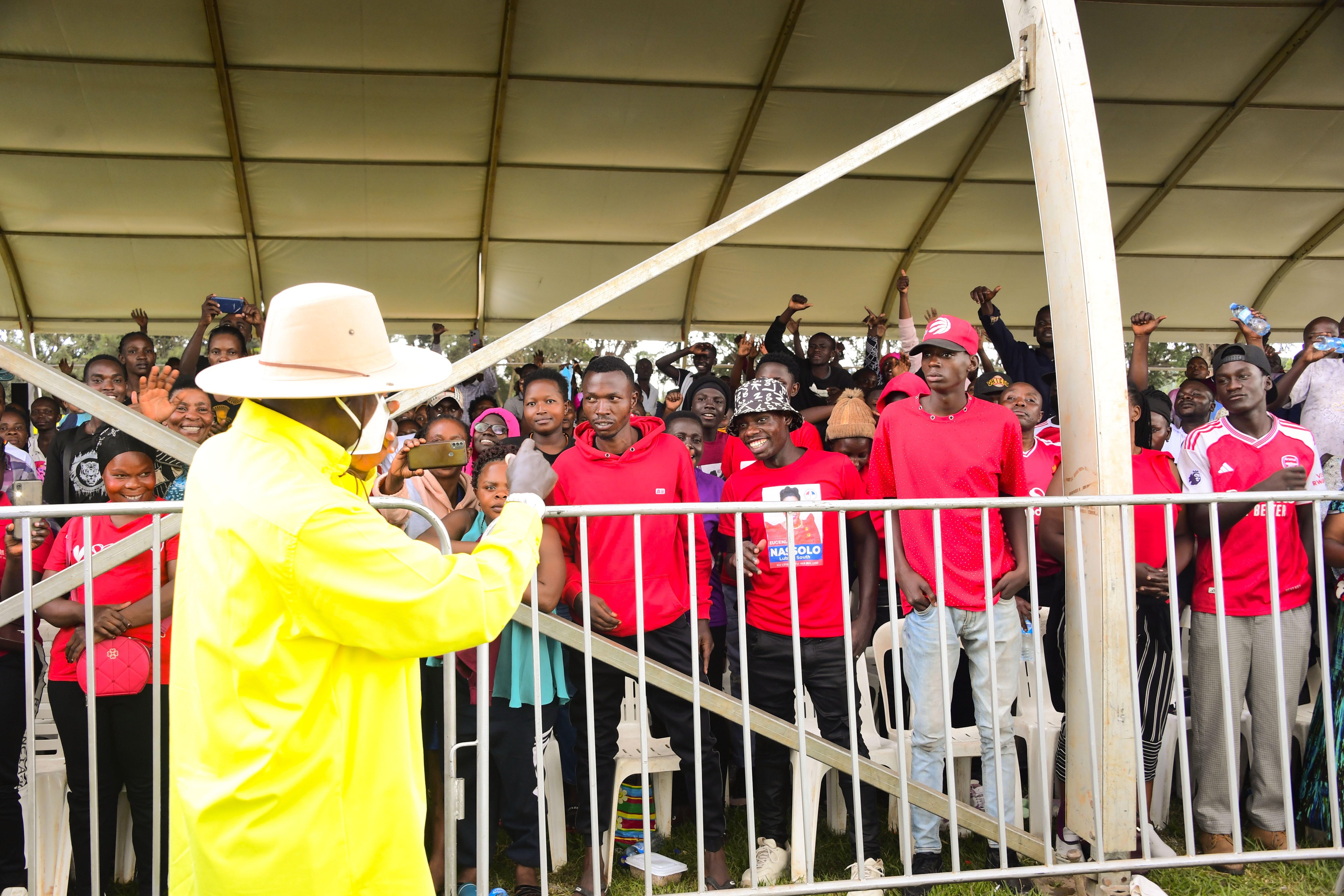
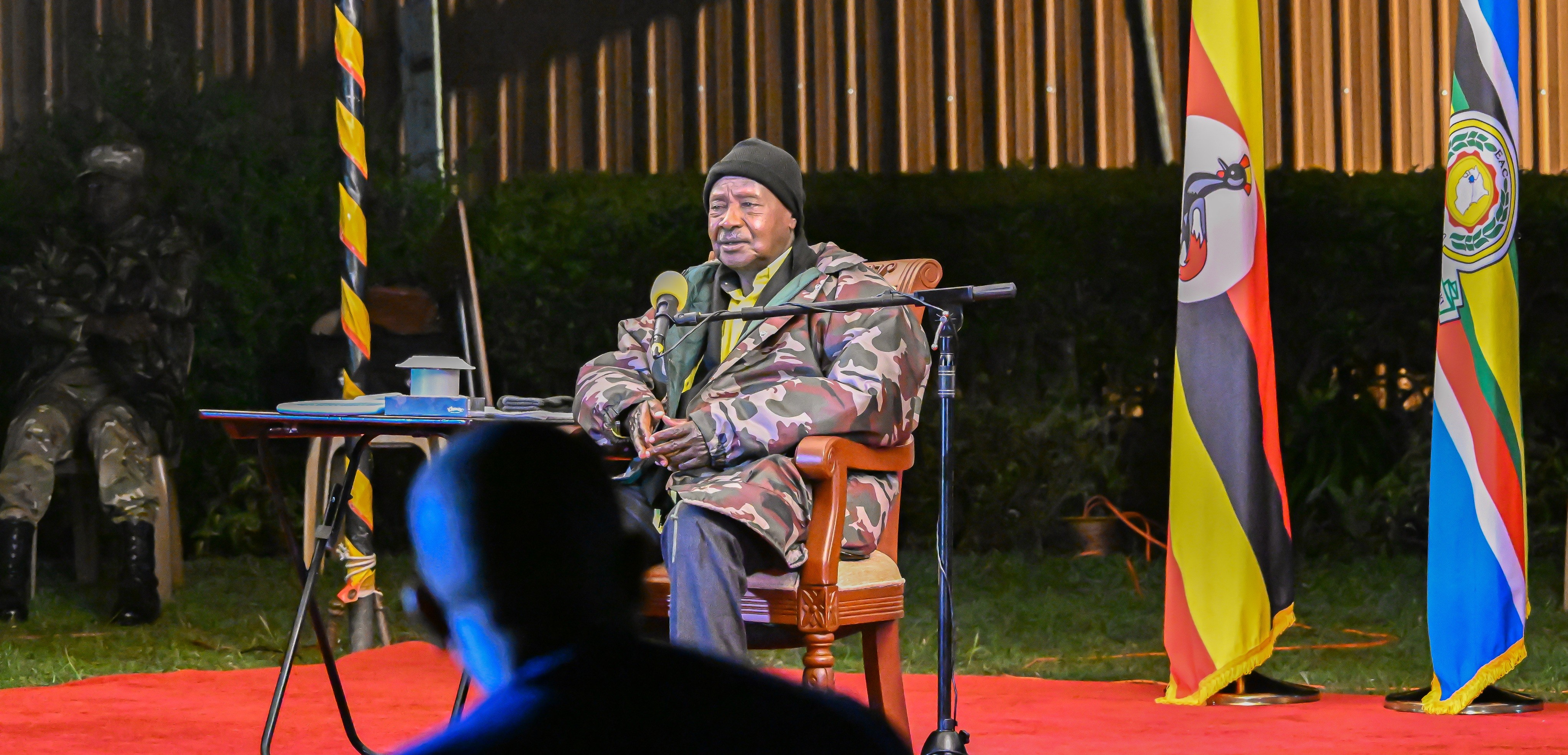
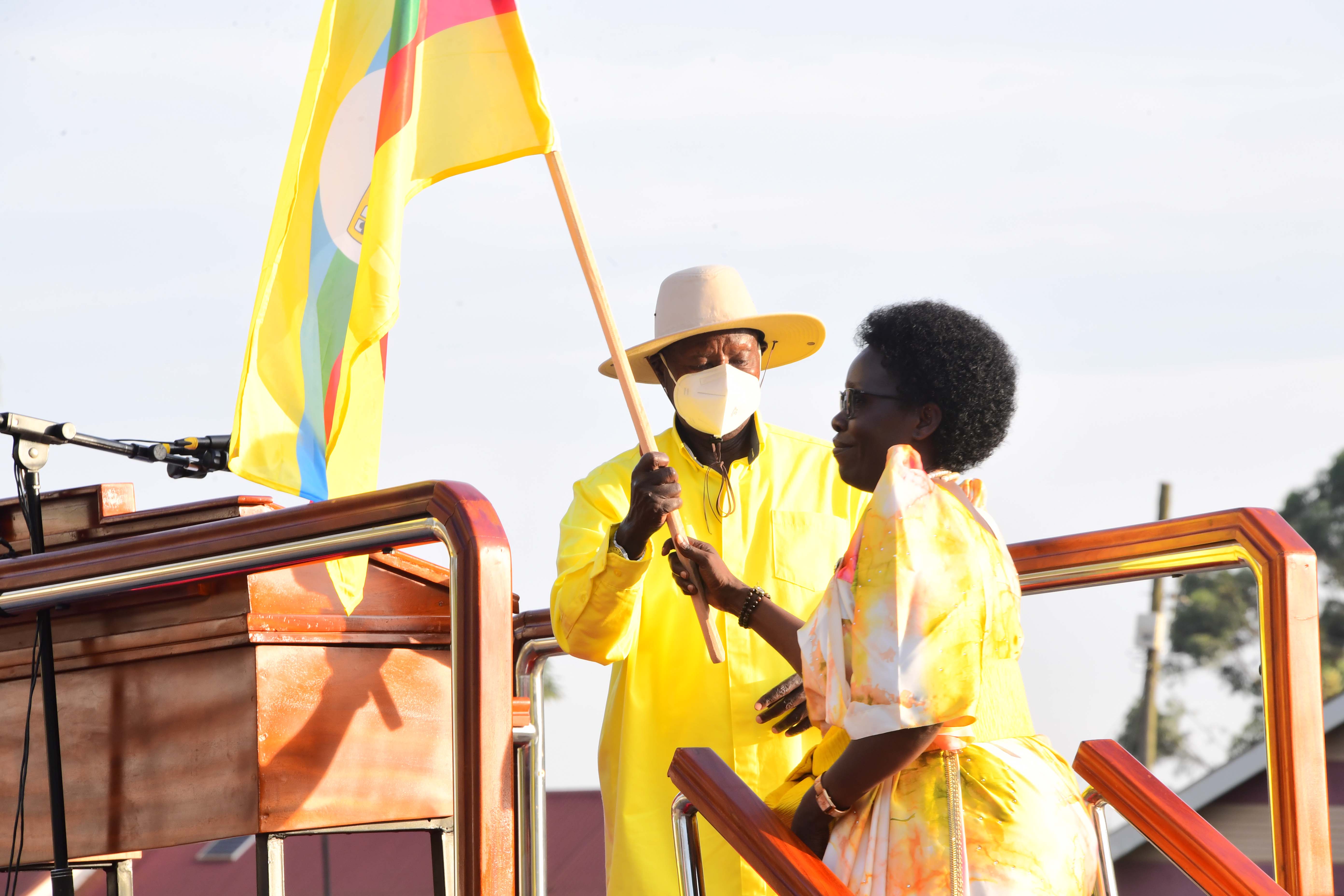
President Yoweri Kaguta Museveni has today launched his Rwenzori Sub-region campaign trail starting with Kasese district at Nyakasanga Playground, Kasese Municipality. Addressing the gathering, President Museveni elaborated on some of the seven contributions the National Resistance Movement (NRM) has made to Uganda over the last 40 years, emphasizing peace, development, wealth creation and job creation as pillars that have transformed the country. He told residents that Kasese is among the best witnesses of peace because of its proximity to the Democratic Republic of Congo (DRC), noting that Uganda is currently hosting 700,000 refugees from Congo who cannot return to their country due to continued instability. The President said groups that attempted to destabilize the district were defeated and peace in Uganda “will remain like ripe bananas—you only see them but you cannot touch or eat them.” On development, the President highlighted both economic and social infrastructure. He said the government has worked on major roads in the area, including Fort Portal–Kasese (done twice), Katunguru–Ishaka, and Kikorongo–Bwera, which will soon be redone. President Museveni added that the government will also work on the Mityana–Kyegegwa road and many others. He further criticized leaders who fail to prioritize key issues, choosing salary increments over infrastructure, noting that prioritization enabled the government to deliver long stretches of tarmac such as Lyantonde–Kazo–Ibanda–Kamwenge. He explained that Kasese and Ntungamo districts require additional road machinery since their annual road fund allocation of Shs 1 billion is inadequate, assuring residents that more equipment will be provided. On electricity, President Museveni reaffirmed the government's vision of connecting every district and every sub-county in Uganda, saying that apart from Buvuma Island, all districts are connected and the next target is full sub-county coverage. He also announced that the government has started repairing the railway line from Malaba and that Kasese will instead receive a new Standard Gauge Railway. He added that after the Hoima airport built for the oil sector, the government will construct another international airport in Kasese to boost tourism. President Museveni said Kasese is doing well in social services, with 260 government primary schools and 25 government secondary schools providing Universal Secondary Education and Universal Post-O-Level Education and Training. He further noted that the district has two hospitals, with continued expansion and upgrading of health facilities planned. On wealth creation, the President reminded the population that development alone does not translate into prosperity unless households embrace productive activities. He re-echoed the four-acre model introduced in the 1996 Manifesto, advising residents to plant coffee, fruits, pasture, food crops, keep poultry or pigs, and practice fish farming where possible. He cited George Matongo of Ngoma as an example of someone who followed the NRM guidance and now earns Shs 21 million monthly from dairy farming despite living in an area without tarmac roads or electricity. He said only 30% of Ugandans remain outside the money economy and urged residents to help mobilise them. President Museveni also warned that he had received reports of individuals stealing the Parish Development Model (PDM) funds and vowed to investigate and arrest the culprits. On job creation, the President emphasized that employment comes mainly from commercial agriculture, services, ICT and factories—not government. He said factories alone have created 1.3 million jobs, compared to 480,000 government jobs. He encouraged youth to utilize skilling centres to acquire employable and wealth-generating skills. The 2nd National Vice Chairperson (Female) and Speaker of Parliament, Rt. Hon. Anita Annet Among, thanked the President for maintaining peace in Kasese despite its border with conflict-hit DRC. She asked the government to upgrade Kasese Airfield into an international airport and appreciated the President for funding interventions along River Nyamwamba, which has long caused flooding and displacement. Kasese District NRM Chairperson Mr. Mbahimba James also praised the President for restoring peace and spurring development, including schools, hospitals, business growth, increased population and improved access to safe water. He thanked him for wealth creation programs such as PDM and Emyooga, saying they have improved household incomes. He raised challenges in Lwehingo, Kabukero and Kyabatukura and requested the President’s intervention.

img
03 December 2025

PRESIDENT MUSEVENI CAMPAIGNS IN MITOOMA, HIGHLIGHTS NRM’S KEY CONTRIBUTIONS TO UGANDA

President Yoweri Kaguta Museveni, accompanied by First Lady and Minister of Education and Sports, Maama Janet Museveni, today held a campaign rally at Kirambe Market in Ijumo Parish, Mitooma Sub County, Mitooma District. During the rally, the President reiterated major contributions of the National Resistance Movement (NRM) to Uganda, starting with peace, which he said the party was able to bring because it rejected politics based on sectarianism—religion, tribe and gender. He said the second contribution is development, which comprises economic and social infrastructure. On social infrastructure, he noted that Mitooma is performing well, with 109 government primary schools and 16 government secondary schools. On health, he said the government will continue strengthening the sector. President Museveni also emphasised wealth creation as the third NRM contribution. He explained that while development benefits all, wealth creation benefits an individual and their family, and poverty remains a personal burden. He reminded those with small landholdings to use the four-acre model to maximise productivity. He noted that some people in the cattle corridor have already transformed their lives by abandoning subsistence farming. Those with large pieces of land, he said, can engage in crops such as cotton and tobacco. He announced that the government will create a revolving fund for tea farmers to help them buy fertilisers and boost production. The fourth contribution, he said, is job creation, which arises from wealth creation—whether through commercial agriculture, factories, services or ICT. President Museveni clarified that jobs do not come from the government as many assume. For those without land or those living in towns, he encouraged the use of skilling centres to acquire skills needed to start income-generating activities. The President promised to expand skilling centres so that more young people can be trained. President Museveni also responded to local concerns, promising to direct the Uganda Wildlife Authority to install an electric fence around the gazetted area to stop wild animals from destroying crops. On her part, Maama Janet thanked the people of Mitooma for their massive turnout and support to NRM. She thanked God for protecting the President and for guiding the NRM, which she said has led Uganda from difficult times to progress. The First Lady also called for continued prayers for the country. She also appreciated Deputy Speaker of Parliament, Rt. Hon. Thomas Tayebwa for reconciling NRM candidates after the party primaries, thus helping to maintain party stability, and the Minister of Internal Affairs, Gen. Kahinda Otafiire for offering wise counsel to the youth, noting that many have grown up under the current government and do not know the hardships of the past. Maama Janet further appealed to the people of Mitooma to vote for President Museveni and other NRM flagbearers. Rt. Hon. Tayebwa said one of the key gains Mitooma is protecting is the Parish Development Model (PDM), which has transformed lives. He thanked the President for granting Mitooma District status, which has brought services closer to the people. He also requested fertilisers to boost coffee production. Gen. Otafiire thanked the President for offering himself again, saying the NRM spent 20 years organising and stabilising Uganda, and the country is now witnessing enormous development from its 40 years in power. He cautioned the public not to be diverted from supporting the NRM, reminding them that many young people do not know what war means or what Uganda went through. Mitooma District NRM Chairperson, Mr. Moses Tumwekwese promised the President 98% support in the forthcoming elections, attributing this to the development the NRM government has delivered, including PDM funds, youth support programmes and improved road network in the district.

img
02 December 2025

SHEEMA: PRESIDENT MUSEVENI REINFORCES NRM ACHIEVEMENTS AND 2026 RE-ELECTION BID

President Yoweri Kaguta Museveni, the National Resistance Movement (NRM) National Chairperson and party flagbearer for the 2026 presidential elections, on Tuesday, 2nd December 2025 intensified his campaign drive with a major rally in Sheema District, where he defended the NRM’s record on peace, unity, development, and wealth creation while unveiling a range of new pledges for the district and wider country. In his address to the thousands of enthusiastic supporters who filled the Kabwohe Playground grounds, President Museveni who was accompanied by the First Lady and Minister of Education and Sports, Maama Janet Kataaha, placed significant emphasis on the NRM’s enduring theme of peace and unity, arguing that Uganda’s transformation from instability to economic progress is rooted in the elimination of sectarian politics and the creation of a national army built on patriotism rather than tribal or religious lines. President Museveni recounted scenes from his earlier Parish Development Model (PDM) tours, recalling how he encountered Ugandans socialising late into the night in village bars across the country. “People were enjoying themselves at 9 pm, drinking and happy. That is what they call peace,” he said. “But unfortunately, many did not know where the peace came from. It came from the good leadership of the NRM.” He argued that before 1986, politics of identity—particularly tribal and religious divisions—made the country ungovernable and robbed it of the opportunity for economic growth. The NRM’s rise to power, he said, shifted Uganda from chaos to stability. “There is no other party that would garner 50 per cent of the vote until the NRM brought unity of religions and tribes and gave affirmative action to women,” President Museveni said, adding that this unity created a mass political force that secured the nation and sustained long-term stability. The President urged Ugandans to continue supporting the “resistance way” of doing things, which he described as a process rooted in prioritisation and long-term planning. He criticized regimes before 1986 for collapsing as a result of attempting to address too many problems simultaneously. “The beauty is that God loves NRM, and He has been granting us more solutions with time. For instance, the discovery of oil. By next year, we shall be using oil money for infrastructure,” H.E. Museveni said, further announcing a major pledge to upgrade key roads in the district once oil revenues start flowing. He promised that the government will tarmac the road network from Buzibwera – Nyakambu – Busiika – Nyakashaka – Nyakabiriizi up to Kabwohe – Bugongi and Kitagata. “These roads will be worked on in the next term of office because we shall have more money from the oil,” President Museveni assured, drawing loud applause from the supporters. The pledge aligns with NRM’s broader infrastructure agenda, which the President described as a cornerstone of national development that enables socio-economic growth and service delivery. President Museveni also highlighted the district’s progress in electricity and water access, as well as education and health services. On water coverage, President Museveni learnt that out of Sheema’s 619 villages, 487 have safe water sources, representing 79% coverage, while 21% (132 villages) remain without access to safe water. President Museveni said these gaps would be addressed as resources increase. Regarding education, Sheema District and Municipality now host 133 government primary schools and 17 government secondary schools. The expansion, President Museveni said, reflects the government’s commitment to education access. On Health facilities, he noted that out of 15 sub-counties in Sheema, 1 has a hospital, 2 have Health Centre IVs, 12 have Health Centre IIIs and only one sub-county lacks any form of health facility. The President announced that the government will construct a new HCIII in Masheruka Sub-County and will consider establishing a district hospital as requested by local leaders. President Museveni also dedicated a significant portion of his speech to re-educating the public about the difference between government-led development and individual wealth creation. He explained that development refers to public goods such as roads, electricity, schools, and water facilities the state provides for national progress. Wealth, however, must be generated by individuals and households through productive economic activities. “That’s why we told you to differentiate between development and wealth,” he said. “Since 1963, the Mbarara–Kasese road has been tarmacked, but poor people are still there despite having a tarmac road.” To escape poverty, President Museveni said Ugandans must use these public goods to engage in commercial agriculture, manufacturing, services, and ICT. He emphasised that government initiatives like the Parish Development Model (PDM) exist to help individuals transition from subsistence to income-generating enterprises. President Museveni reinforced his argument by highlighting several successful Ugandans who used small government interventions or modest resources to build lucrative enterprises. Examples included George Matongo of Ngoma (Nakaseke), who sells 900 litres of milk daily, earning around Shs 21 million per month, despite living 70 miles from a tarmac road. Johnson Basangwa, a major poultry farmer in Kamuli earns about Shs 20 million per day from egg sales and employs over 300 workers. The President also revisited the longstanding 4-acre model, encouraging farmers with small landholdings to diversify into coffee, fruits, livestock pasture, and food crops, supplemented by backyard activities such as poultry and piggery. On the other hand, President Museveni reassured tea farmers that the government will stabilize prices and correct earlier missteps in the sector. He announced that a special financing scheme—similar to PDM—will be introduced to help tea farmers access loans for fertilizers and other inputs. “The funds will go crop by crop, including cocoa,” he said, promising broader support for commercial crop enterprises across Uganda. Turning to unemployment, President Museveni dismissed the notion that the government is the primary source of jobs. “Government jobs are few, only 480,000 altogether, but 1.3 million people are employed in factories and manufacturing,” he said, emphasizing that the private sector, especially commercial agriculture, industry, ICT, and services, is the true engine of job creation. He cited the example of factories in Mbale Industrial Park, which employ 12,000 Ugandans in just one square mile, three times fewer than those employed in Namanve. The President also championed the Presidential Skilling Hubs, which offer free vocational training and have already produced thousands of young entrepreneurs. Testimonies from beneficiaries included Nimusiima Ritah from Sheema, who dropped out in S.4 but trained in tailoring at the Mbarara skilling hub. She now runs her own business—God’s Mercy Super Tailors—employs two people, and earns Shs 650,000 in monthly profit. Similarly, Kakuru Polly from Sheema Municipality, who trained in hairdressing and now owns God’s Mercy Salon and employs two people. President Museveni further issued a stern warning to officials involved in the embezzlement of PDM funds meant for the poorest households. He vowed to order arrests for all perpetrators, citing reports that some beneficiaries were not receiving the mandated Shs 1 million. Sheema District and Municipality, which have 74 parishes, have so far received Shs 24.9 billion in PDM funds, of which Shs 21.47 billion (85.9%) has been disbursed to 22,062 households—representing 37.8% of all households. This means 62.2% of the district’s 58,374 households, totaling 36,312, have not yet received support. Maama Janet also addressed the gathering where she thanked residents for their overwhelming support and expressed gratitude for God’s protection over Uganda. “On the voting day, please turn up in such big numbers and vote for President Museveni and all NRM members as you have promised,” she urged. NRM Secretary General, Rt. Hon. Richard Todwong praised Sheema residents for their loyalty to the party and described the campaign rally as a learning session for citizens. “Thank you for the love you have shown. To me, this is a classroom. Ours is to prepare the classroom for the teacher to continue teaching us. The President is not just campaigning—he is teaching,” Rt. Hon. Todwong said. The rally was attended by several senior government and party officials, including Deputy Speaker of Parliament, Rt. Hon. Thomas Tayebwa, Members of the NRM Central Executive Committee, ministers, veteran NRM supporters, among others.

img
02 December 2025

PRESIDENT MUSEVENI RALLIES BUSHENYI TO VOTE NRM, WARNS PDM FUND THIEVES

President Yoweri Kaguta Museveni, accompanied by the First Lady and Minister of Education and Sports, Maama Janet Museveni, today addressed thousands of NRM supporters at Kizinda Market in Bushenyi – Ishaka Municipality, issuing a strong warning to Parish Development Model (PDM) officials who charge or steal from beneficiaries. He vowed to decisively deal with anyone sabotaging a programme meant to lift Ugandans out of poverty. During a massive campaign rally, President Museveni also revisited the seven NRM contributions to Uganda, stressing peace as the most critical. He said countries like Sudan—where people are “dying like flies”—are suffering because of sectarian politics based on tribe and religion. “Uganda was heading in the same direction, but when the NRM came, it stopped all that. We created a strong national party and strong institutions like the army and police. When you vote NRM, you are not helping Museveni; you are helping yourself,” he said. On development, the President highlighted achievements in economic infrastructure. Bushenyi District, which now has 17 sub-counties/town councils, 72 parishes, and 571 villages, has benefited from major road projects including the Ishaka–Kasese road and the Ishaka–Kagamba road. President Museveni announced that the government will construct the Mbarara–Ishaka road, with funds already available, and will upgrade the Bwizibwera–Nyakambu–Buhweju–Nyakashaka–Nyabirizi route. On electricity, he noted that 15 of the 17 sub-counties in Bushenyi are already connected, with the government set to extend power to Kyamuhunga Sub-county and Bitooma Town Council in the next term. President Museveni also highlighted progress in social infrastructure. Bushenyi District and Bushenyi–Ishaka Municipality have 151 government primary schools and 155 private primary schools, as well as 16 government secondary schools and 67 private secondary schools. Of these, 13 government secondary schools provide Universal Secondary Education (USE) and Universal Post-O-Level Education and Training (UPOLET), with a total enrolment of 9,470 students. The President also urged residents to differentiate between development and wealth creation. “Tarmac roads and electricity do not mean you have wealth. Wealth creation is for the individual,” he said. He encouraged adoption of the four-acre model, noting that although Bushenyi is known for dairy farming, many are reluctant to plant pasture, which limits productivity. He cited Joseph Ijara of Serere as an example of a farmer who increased output after planting pasture. President Museveni further reported that the number of households outside the money economy has reduced from 68% to 30%, thanks to increased production in coffee, milk, palm oil and growth of industrial parks. On job creation, he said jobs come from commercial agriculture, factories, ICT and the services sector. He cited Hon. Fred Byamukama, the Minister of State for Transport, who employs 26 people after embracing the four-acre model. Maama Janet thanked Bushenyi residents for turning up in large numbers and supporting the NRM. “The peace you have must be protected. The only way to protect these gains is by voting NRM and encouraging your family members and friends to vote. Do not stop at attending rallies—come and vote on polling day,” she urged. Bushenyi District NRM Chairperson, Hajji Hassan Basajjabalaba thanked the President for the enormous development in the district, including the banana factory and road network. He requested the introduction of a national medical insurance scheme and appealed for an industrial park in Bushenyi.

img
01 December 2025

PRESIDENT MUSEVENI RALLIES MBARARA TO VOTE FOR NRM FLAGBEARERS IN 2026 GENERAL ELECTIONS

President Yoweri Kaguta Museveni, accompanied by First Lady and Minister of Education and Sports, Maama Janet Museveni, was this afternoon received by thousands of supporters at Booma Grounds in Mbarara City as he continued his campaign trail in Ankole Sub-region. At the rally, the President addressed residents from both Mbarara district and city where he rallied them to vote for the National Resistance Movement (NRM) flagbearers in the 2026 general elections. President Museveni also highlighted the first NRM contribution to Uganda—peace, recalling the turmoil the country faced in 1972, 1979 and 1985. He said today the country enjoys peace “from border to border” because the NRM rejected sectarian politics based on religion, tribe, gender and other divisions, enabling the establishment of strong institutions such as the police, army and judiciary. The second contribution—development, he said, comprises economic and social infrastructure. President Museveni pointed to improvements in the national road network under the NRM government, including the rehabilitation of old roads, and announced that the government will construct the Biharwe– Bwizibwera road. He added that electricity coverage has significantly expanded and “is almost everywhere.” On wealth creation, the President urged Ugandans to shift attention from development alone to improving household income. He cited the example of George Matongo of Ngoma, who earns Shs21 million per month from dairy farming despite living far from tarmac and electricity. President Museveni encouraged families with small landholdings to adopt the four-acre model: coffee in the first acre, fruits in the second, pasture for zero-grazing dairy cows in the third, food crops in the fourth, and enterprises such as poultry, piggery or fish farming in the backyard. He said the NRM government is the only one in Africa that gives citizens money to help them overcome poverty, arguing that infrastructure alone is not useful if citizens remain poor. For urban residents, he highlighted skilling centres that offer training in hairdressing, tailoring, welding, brickmaking, bakery and more—skills that can create wealth even for those without land. President Museveni added that 30% of Uganda’s population remains outside the money economy, and this is the group he is determined to integrate. He listed job creation as the fourth NRM contribution, noting that jobs come from commercial agriculture, services, ICT and factories. The President appealed to the people of Mbarara to continue supporting the NRM, saying the party has already demonstrated its contributions to Uganda. On her part, Maama Janet praised the unity and overwhelming support to NRM by the people of Mbarara. “Today the people of Mbarara have spoken to the whole of Uganda without saying anything. You have made a big statement. I want to request you to continue doing grassroots mobilisation house to house and aim at getting 99.9% in Mbarara in the coming election for the NRM. Most people say that when you come in big numbers like this, it means that it’s an automatic win for NRM, but you need to go an extra mile—look for more votes and encourage them to come on the voting day and vote for the NRM,” she said. Mbarara District NRM Chairperson, Mr. Atuheise Prosper hailed the President for founding a party that has united Ugandans and rejected sectarianism based on tribe, religion or political affiliation. He also thanked the President for the development programmes in the district, including the Parish Development Model and improved road networks. Mbarara City NRM Chairperson, Mr. Wilson Tumwine thanked the President for approving the upgrade of Nyakisharara Airfield into an international airport. He also requested the construction of a stadium in Mbarara City to boost sports development and nurture local talent.

img
01 December 2025

RWAMPARA: PRESIDENT MUSEVENI CAUTIONS LEADERS AGAINST DENYING YOUTH PDM FUNDS OVER LACK OF LAND

President Yoweri Kaguta Museveni has directed Parish Development Model (PDM) officials across the country to stop denying youth access to PDM funds over claims that they lack land, insisting that the viability of youth projects, not land ownership, should be the basis for approval. The President who was accompanied by the First Lady and Minister of Education and Sports, Maama Janet Kataaha Museveni, issued the directive on Monday, December 1, 2025, while addressing thousands of supporters at Bujaga Playground in Rwampara District during a campaign rally ahead of 2026 general elections. The President expressed strong dissatisfaction with reports that youth in several parishes have been turned away from accessing the PDM revolving fund because they do not own land—an issue he described as “misguided and unacceptable.” “For the youths, I have heard reports that elders are not allowing them to access PDM at the parish because they don’t have land,” President Museveni said. “Stop that. Get their projects and review them and leave them to invest in whatever they want. They can rent land to invest in anything they wish.” He emphasized that PDM was designed to give all Ugandans, especially the vulnerable ones still in the subsistence economy, a fair chance to enter income-generating activities. Land ownership, he said, is not a prerequisite for innovation or entrepreneurship. He cited examples of youth who have used the funds creatively, including Ayesigwa Kenneth, a young man from Nyamirama in Kanungu District who used his PDM allocation of Shs1 million to hire space for a small restaurant, later expanding into piggery—demonstrating innovation through minimal resources. “These excuses of saying someone has no land and therefore should not get money—I don’t want to hear this,” President Museveni insisted. “Look at the viability of their project before denying them money.” Under the PDM framework, 30% of the parish revolving fund is ring-fenced for youth aged 18–30 to support their participation in income-generating ventures. President Museveni reminded Rwampara residents that the NRM government has always combined guidance with practical support. “NRM doesn’t only advise and show you what to do, but also supports you to start,” he said. “Use this PDM money well and you will be prosperous.” He revealed that the government plans to supplement PDM funds with free coffee seedlings for households ready to embrace commercial agriculture. “I have already informed the relevant departments to get coffee seedlings and give them for free to those who need them,” he added. President Museveni, who is also the NRM presidential flag bearer, used the rally to reinforce the central focus of his re-election message—peace, development, wealth creation, and job creation—while unveiling highlights of the NRM’s 2026–2031 manifesto. The President reminisced about his earlier years in Rwampara, describing the area as a place filled with personal and historical significance. He recalled that he first passed through Bujaga 68 years ago in 1957, walking from Kyamate to play football. He also noted that he traversed the area during the liberation struggles of 1979 and 1985. “It feels good to be back here and seeing you in good health,” the President told the cheering crowd. President Museveni used the rally to reintroduce key pillars of the NRM’s five-year manifesto, focusing on four of the seven commitments: peace, development, wealth creation, and job creation. He said Uganda’s enduring peace is one of the NRM’s greatest achievements. “We were in wars twice, in 1979 and 1985. What caused those wars was the politics of identity—tribe, religion—making it difficult to run the country,” he said, arguing that by uniting Ugandans and building a national army not based on sectarian lines, the NRM restored stability, enabling economic growth. “I want you to support this peace to continue,” he appealed. President Museveni highlighted major infrastructure improvements in Rwampara, praising the district for the progress made under NRM. He noted that the main road through Rwampara was tarmacked in 1963 and has since been repaired several times by the government, opening many connecting routes across the district. “We shall upgrade Buteraniro– Bugamba–Rwoho–Bukoni–Kitwe road and Ruti–Mwizi–Kikagate road,” he announced. These, he said, will boost trade, ease mobility, and reduce transport costs. President Museveni also addressed the issue of water for irrigation, noting that Rwampara is blessed with abundant water sources but is underutilizing them. He referenced the government banana plantation in Nyaruzinga, Bushenyi, run by Prof. Florence Muranga, where irrigation from a swamp supports yields of up to 53 tons of bananas per acre—ten times the average yield in surrounding areas. On health, President Museveni applauded Rwampara’s improvement in health services, noting that the district’s eight Sub-counties now host 2 Health Centre IVs and 6 Health Centre IIIs. “All eight sub-counties have a health facility. In the 1990s, the whole of Rwampara County had only three drug dispensaries. This is great progress,” H.E. Museveni said. He committed to delivering a district hospital in the next term, responding to local leaders’ appeals for a major health facility at Bugamba to serve hard-to-reach areas. On education, Rwampara District currently has 74 government-aided primary schools with 35,148 pupils and 7 government-aided secondary schools with 3,954 students, 20 of the 29 parishes host at least one government primary school, while nine parishes still lack one. President Museveni compared the current progress to the limited secondary school options available in the 1950s, saying: “In 1953, we had only Kisubi, Buddo, and Ntare for A-Level studies. Today, Rwampara alone has seven secondary schools. I feel happy.” President Museveni stressed that while development is a public good provided by the government, wealth creation remains a personal effort—rooted in commercial production. He highlighted several examples of successful farmers and entrepreneurs who used small resources to build large enterprises, including George Matongo of Ngoma in Nakaseke district, who now sells 900 litres of milk per day, earning Shs 21 million per month, despite being 70 miles from the nearest tarmac road. Johnson Basangwa, a major poultry farmer from Kamuli, who earns an estimated Shs20 million per day from egg sales and employs more than 300 workers, was highlighted as another success story. Similarly, Korea Dick Ogira from Abim District received 200 mango seedlings from Operation Wealth Creation and Shs880,000 under the Parish Development Model (PDM). He planted two acres of cassava and now earns about Shs6 million from each harvest—conducted twice a year—totaling Shs 12 million annually. With the growing market provided by the Soroti Fruit Factory, his annual income is projected to rise to Shs36 million. “These people have no tarmac roads, but they are rich,” President Museveni said, urging residents of Rwampara to draw inspiration from such examples and replicate their success. Job Creation: The President reiterated that Uganda’s sustainable jobs come from four sectors: Commercial agriculture, Manufacturing, Services, and ICT, warning that government jobs remain limited. “The government has only about 480,000 jobs, yet factories employ about 1.2 million people,” he said. President Museveni showcased the Sino-Mbale Industrial Park, describing it as “a town of 75 factories,” and a key contributor to employment and economic diversification. In her remarks, Maama Janet thanked the people of Rwampara for turning up in large numbers and emphasized the value of the peace Uganda enjoys. “Countries with no peace have their people seeking refuge in Uganda,” she said. “Their only hope is in Uganda because of its peace from border to border.” She encouraged residents not to assume the election was already won, urging them to turn out and vote in large numbers on polling day. Rwampara District NRM Chairperson, Mr. Gordon Mutima welcomed the President and thanked him for elevating Rwampara from a county to a district in 2019, with headquarters in Kinoni Town. He reiterated the district’s request for a district hospital at Bugamba to improve service delivery in the underserved sub-counties. The rally was attended by ministers, Members of Parliament, NRM leaders, and party flag bearers.

img
29 November 2025

PRESIDENT MUSEVENI PLEDGES COFFEE PROCESSING FACILITY FOR IBANDA, HIGHLIGHTS NRM ACHIEVEMENTS

President Yoweri Kaguta Museveni, the National Chairman of the National Resistance Movement (NRM) and the party’s flag-bearer for the 2026 elections, has pledged to support coffee farmers in Ibanda District by establishing a coffee processing facility aimed at boosting productivity, improving quality, and raising household incomes through value addition. President Museveni made the commitment on Saturday, 29th November 2025, while addressing thousands of supporters during a campaign rally at Kagongo Demonstration School playground in Ibanda District, as he intensified his campaign trail across the Ankole sub-region. Ibanda, one of Uganda’s significant coffee-producing districts, grows both Arabica and Robusta varieties, with Arabica thriving particularly well in areas that lie within the high-altitude ranges of the Rwenzori Mountain ecosystem. Coffee farming remains one of the backbone economic activities for the district’s households, making the President’s pledge a major development prospect for the region. “You, the people of Ibanda, already know what to do. Therefore, I will help you establish a coffee processing facility that you have proposed here to add value to your coffee,” President Museveni told the cheering crowd. He added that the government would continue supporting farmers under the Parish Development Model (PDM), including providing free coffee seedlings from both government nursery beds and his personal nurseries at Kisozi. “We shall continue with the PDM money and also give you free coffee seedlings from the government nursery beds that we shall establish,” President Museveni said. “PDM will continue where people invest in whatever they want—poultry, pigs, goats, and others.” The NRM Chairperson for Ibanda District, Hon. Jovrine Kaliisa Kyomukama, highlighted the district’s impressive coffee footprint. She noted that the district has 28,062 acres under coffee cultivation, producing an estimated 14,381 tons annually and earning up to Shs 178 billion in revenue. Despite these gains, Hon. Kyomukama said farmers still face challenges, particularly the shortage of modern coffee dryers, hullers, and processing equipment at the parish level, making value addition difficult. “The coffee you gave us through PDM has done wonders, leading to improved coffee production at the household level,” she told the President. “But we need dryers per parish and coffee hullers.” Residents at the rally shared testimonies reflecting the district’s growing prosperity from commercial agriculture. Mr. Mutabaazi Wilbroad, a coffee farmer from Nyabuhikye Sub-county, revealed that he earns more than Shs 40 million per season from his 8-acre coffee farm. “From one acre, I get about Shs 8 million per season, meaning Shs 16 million per year,” he said. President Museveni praised such success stories, saying coffee has transformed the livelihoods of many households across Uganda. He noted that Uganda now earns US$2 billion annually from coffee exports, making it one of the country’s biggest sources of foreign exchange. “Coffee has created wealth for households and for the country as well,” he emphasized. According to official statistics presented at the rally, Ibanda District has shown strong progress in PDM implementation. Ibanda District (40 PDM SACCOs) received Shs 14.39 billion, of which Shs 12.39 billion (86.07%) was disbursed to 12,391 households, while Ibanda Municipality (21 PDM SACCOs) received Shs 7.50 billion, of which Shs 6.45 billion (85.96%) was disbursed to 6,454 households. In total, Ibanda District and Municipality have received Shs 21.9 billion. President Museveni encouraged parish and sub-county leaders to ensure the remaining households also benefited. He, however, cautioned the public against confusing development with wealth creation. “Development is for all of us - schools, roads, hospitals. But wealth and poverty are personal. We need households to embrace wealth creation,” he said, revisiting the 4-acre model that the government introduced in the 1996 manifesto. Under the model, farmers are encouraged to allocate one acre to coffee, one to fruits, one to food crops, and one to zero-grazing livestock, while using backyards for poultry, piggery, or fish farming. President Museveni used the Ibanda rally to highlight the seven key contributions of the NRM as featured in the 2026–2031 manifesto. He reminded voters of the importance of peace in the region, noting that threats from armed groups that previously operated in the Kamwenge forests had been neutralized. “You, the people of Ibanda, know what peace means,” he said. “Those who wanted to disrupt this peace were dealt with.” On development, President Museveni emphasized ongoing and upcoming infrastructure projects, including major road works across the region. He assured residents that the Mbarara–Ibanda road would be repaired afresh, while other routes—including Ishaka–Bushenyi, Ibanda–Kagongo–Kabujogera–Kamwenge, and Nyamarebe–Kyegegwa—would also be fully rehabilitated. He further promised to consider establishing a ferry on Lake George to boost trade between Rubanda, Rubirizi, and Kasese districts. According to Hon. Kyomukama, the absence of a reliable transport system across the lake currently forces residents to use risky alternatives, especially when transporting livestock to markets. On the side of social infrastructure, the President acknowledged that Ibanda performs well in accessibility to government schools and health facilities, but advised residents to prioritize wealth creation alongside development, saying it's through wealth that jobs are created. President Museveni pointed to the growing number of industrial parks—such as Sino-Mbale Industrial Park with 75 factories and Namanve Industrial Park with over 270 factories—as evidence of the NRM’s commitment to job creation. “These employ far more Ugandans than government institutions, which have only 480,000 jobs for a population nearing 50 million,” he said. To illustrate opportunities in commercial agriculture, President Museveni cited success stories such as Johnson Basangwa, a poultry farmer in Kamuli who produces 200 trays of eggs daily and earns Shs 20 million per day, employing 300 workers. Another example was of Mr. George Matongo, a dairy farmer from Ngoma, Nakaseke, who produces over 900 litres of milk daily, earning about Shs 21 million per month, despite living far from tarmac roads or electricity. Ibanda has historically been an NRM stronghold, and in the 2021 Presidential Elections, out of 140,486 registered voters, 90,801 (64.6%) turned up, with President Museveni winning 77,521 votes (87.3%). For the 2026 elections, Ibanda has 153,810 registered voters, an increase of 13,324. Polling stations have grown from 280 in 2021 to 410. Saturday’s rally attracted prominent NRM leaders, including Speaker of Parliament and party's Second National Vice Chairperson, Rt. Hon. Anita Annet Among, NRM Vice Chairperson for Western Uganda, Eng. Asiimwe Jonard, district leaders, and other senior party officials.

img
29 November 2025

“BUHWEJU’S LONG- AWAITED ROAD SET FOR CONSTRUCTION,” PRESIDENT MUSEVENI REVEALS

President Yoweri Kaguta Museveni, also the National Resistance Movement (NRM) Presidential flag bearer for 2026 general elections, today held his first campaign rally of the day in Buhweju District. Addressing thousands of his supporters at Engaju Secondary School in Buhweju, the President announced that the long-awaited Bwizibwera– Nyakambu– Nsiika–Nyakashaka–Nyakabirizi road is going to be constructed. “We have not worked on this road, but now the China Railway 18th Bureau Group is ready. They are securing Shs 30bn to compensate those affected along the road, after which construction will start immediately,” he said. President Museveni emphasized the value of peace in Buhweju, noting that the district borders Kasese, which has experienced insecurity linked to conflicts in neighboring Congo. “I once passed through Buhweju by car and found the people well-rested and enjoying their evening. That’s peace,” he said. “Uganda was never easy to manage in terms of peace. So, when opposition leaders come asking, can you manage peace, I say, Buhweju knows what NRM has done,” he added. Recalling a recent meeting with local leaders, he narrated a story about a man named Ngoma Elanze, born in Congo in 1964 when Patrice Lumumba was killed and the country was in turmoil. “At one time, Uganda was once also ‘Ngoma Elanze’, but NRM restored peace,” he said. The President noted that out of 348 villages in Buhweju, 261 now have safe water, meaning 75% of the district enjoys access to clean water. On health, he highlighted that in 1980, Buhweju’s population was 34,000, growing to 167,000 today. “This growth shows the success of our immunization program. All these children are NRM children,” he said. President Museveni also outlined plans to expand healthcare in the district; upgrade Nsiika HCIV to a General Hospital, upgrade Engaju HCIII to HCIV and construct new HCIIIs in Kashenyi-Kajani, Nyakaziba, Rubengye, and Rwengwe sub-counties. Ongoing works include upgrading Bitsya HCII to HCIII, staff house construction at Kiyanja HCIII, and renovations at Karungu and Burere HCIIIs. Education in Buhweju has also grown, with 56 government primary schools and 130 private primary schools, reflecting the community’s ability to invest in education. He mentioned that the district has seven government secondary schools, with more under construction. “All 140 sub-counties will eventually have government secondary schools,” President Museveni said. The President also highlighted the story of Ms. Mary Getrude Kyomugasho from Nyakashaka Town Council, a primary seven school dropout. With support from a government skilling program, she trained in tailoring and knitting, developed her skills, and started her own workshop. “Today I have three machines and two employees. I pay them Shs 5,000 per day, and I continue growing my business. Thank you, President Museveni, for changing my life,” she said. President Museveni praised Kyomugasho, saying, “She has got a skill and capital, and that is what creates jobs.” The President emphasized that while Uganda has made enormous strides in development, household wealth must now be the focus. He clarified the long-standing confusion between development and wealth creation, noting that urban centres enjoy vast infrastructure, yet some residents remain poor. He outlined the four pillars of wealth creation including; commercial agriculture, manufacturing and factories, services such as hotels and transport and ICT. President Museveni reminded the supporters that after securing peace, the NRM introduced the Four-Acre Model in the 1996 Manifesto as a practical pathway out of poverty. He explained the model; one acre for coffee, one acre for fruits, one acre for pasture for dairy cattle, one acre for food for the family and then backyard poultry or piggery, and fish farming for communities near wetlands. The President also handed over the NRM flags to aspiring Members of Parliament, LC V chairperson, councillors, and other party candidates in Buhweju District, formally endorsing their participation in the upcoming elections. Rt. Hon. Anitah Among, Speaker of Parliament and NRM’s Second National Vice Chairperson (Female), praised the President, saying: “We welcome you, Your Excellency, to Buhweju. Thank you for coming to campaign in our district. We appreciate your leadership and the work you continue to do for our communities.” Rt. Hon. Among specifically commended the President for including the Bwizibwera–Nsiika–Nyakashaka–Nyakabirizi road in the National Development Plan IV (NDP IV). “The road is in dire need of repair, and the people of Buhweju are grateful knowing that work will commence soon,” she said. She further thanked the government for the Buhweju Tea Factory, noting that Shs 310 billion has been provided to support tea farmers and processors. She urged the farmers to continue improving production. Eng. Jonard Asiimwe, the Vice Chairman-NRM Western Uganda, welcomed the President and assured him of strong mobilization efforts in the district. He highlighted achievements in coffee production, tourism, and mining, noting the need for improvements in the mining sector. The Buhweju NRM Chairperson, Mr. Godfrey Kabandize, presented a Memorandum of Understanding that shared detailed insights on the district’s demographics and development progress. He noted that Buhweju has 14 Sub-Counties/Town Councils, 68 Parishes, and 348 villages, with a population of 167,921. In 2025, the district had 77,082 registered voters, an increase of 10,433 since 2021, and now operates 223 polling stations, up from 182. Mr. Kabandize also highlighted the Parish Development Model (PDM), noting that out of 35,305 households, 21,762 households (61.6%) have already benefited from PDM funds totaling Shs 20.8bn. “The remaining 13,543 households (38.4%) are still to benefit, including those already engaged in the money economy,” he said. The district has also made strides through Emyooga SACCOs, which now include 36 SACCOs with 10,020 members, receiving a total of Shs 1.46bn from the government to support small-scale business and entrepreneurship. Buhweju has 56 government primary schools and 103 private schools, yet 29 of 68 parishes still lack access to a government primary school. On the secondary education front, the district has 7 government and 17 private secondary schools, enrolling 2,506 students. All government schools provide Universal Secondary Education (USE) and Universal Post-Ordinary Level Education and Training (UPOLET). Three Seed Secondary Schools are currently under construction, which will reduce the number of sub-counties without a government secondary school from 7 to 4, a move hailed as critical for improving access to quality education across the district. In healthcare, only one HCIV and nine HCIII facilities currently serve the district, leaving four sub-counties without a health facility. Planned upgrades include Nsiika HCIV to a General Hospital, Engaju HCIII to HCIV, and the construction of new HCIIIs in Kashenyi-Kajani, Nyakaziba, Rubengye, and Rwengwe sub-counties. Ongoing projects such as the upgrade of Bitsya HCII to HCIII and renovations in Karungu and Burere health centers are expected to improve service delivery. Access to safe water has improved significantly, with 261 out of 348 villages (75%) now served. The government has completed multiple interventions, including protected springs, gravity flow schemes, and rainwater harvesting tanks. Piped water systems in Nsiika, Rwamwanja, Kajani-Kasheni, Rutehe, Kayonza, and Kyamuhunga now serve thousands of residents. Efforts in water for production have also begun to pay dividends. Small-scale irrigation schemes in Kyisa (5 acres producing 5.5 tons of tea) and Kyesika (12 acres producing 2.5 tons of tea) now generate Shs 9.9 million and Shs 7 million annually, respectively, benefiting local farmers and demonstrating the potential of irrigation to boost livelihoods. Meanwhile, Buhweju District is now fully connected to the National Electricity Grid, opening new opportunities for businesses, households, and public services. Mr. Kabandize concluded by reaffirming Buhweju’s support for the President. “Through NRM structures, the people of Buhweju are ready to support you 100%. We are committed to ensuring that every development initiative succeeds in our district,” he said. The event was attended by NRM Central Executive Committee (CEC) members, Members of Parliament, religious and cultural leaders, as well as thousands of supporters.

img
28 November 2025

PRESIDENT MUSEVENI RALLIES KIRUHURA AND KAZO TO EMBRACE PROFITABLE DAIRY FARMING

President Yoweri Kaguta Museveni has urged residents of Kiruhura and Kazo districts to fully exploit their vast land for commercial dairy farming, saying the cattle corridor has the potential to become Uganda’s largest hub of milk-based wealth creation if farmers abandon free-range grazing and adopt intensive production systems. Addressing thousands of supporters at Nyakasharara playground in Kiruhura District on Friday, 28th November 2025, President Museveni, accompanied by the First Daughter, Pastor Patience Rwabwogo, praised the community for gradually shifting from nomadic livestock rearing to commercial dairy farming but insisted that greater transformation is still possible. “The people of Kiruhura and Kazo, and the entire cattle corridor, thank you for heeding our advice on working and grazing cows for wealth creation. But do not stop,” he said. “Free-range grazing makes the land underutilized. On one square mile, you are managing only about 130 cows. But if you adopt zero grazing, you can keep thousands of cows on the same land,” the President emphasized, adding that wealth creation, not mere ownership of land or livestock, is central to Uganda’s household prosperity agenda. President Museveni illustrated his message with success stories of farmers who have built thriving enterprises on small pieces of land by adopting modern practices. One such farmer is Joseph Ijala, a former taxi driver who now runs an integrated farm on 2.5 acres. Ijala started with poultry and expanded into dairy farming. He keeps 10,000-layer chickens, producing 310 trays of eggs per day and earning more than Shs 3 million daily. On just 1.5 acres of land, Ijala also practices zero-grazing dairy farming with eight cows, producing a substantial amount of milk daily. Combined, he earns about Shs 6.8 million per month from eggs and milk. President Museveni said Ijala’s example demonstrates how zero grazing drastically increases productivity. “Ijala keeps eight cows on one acre. If that were a square mile, he would keep over 4,000 cows,” he said. Another example is Richard Nyakaana, a farmer in Kabarole whose Kana Farm sits on only 1.2 acres. Nyakaana runs a range of enterprises, including layer poultry, zero grazing, feed processing, and manure production. With only six milking cows, he produces 120 litres of milk per day, earning Shs 110,000 daily, amounting to Shs 20 million annually in profit. “You people in the cattle corridor have a lot of land. Use that land profitably,” President Museveni urged. “The third contribution of the NRM is wealth creation. Development benefits everyone, but wealth and poverty are yours as a household.” President Museveni also cited George Matongo, a dairy farmer from Ngoma in Nakaseke, as a symbol of the transformative power of commercial agriculture. Matongo, who reportedly never attained formal education and lives far from infrastructure such as tarmac roads or electricity, produces over 900 litres of milk per day and earns an estimated Shs 21 million monthly. “Matongo is extremely prosperous, yet he lives far from a tarmac road or electricity,” H.E. Museveni said. “Meanwhile, people are living next to smooth tarmac roads, but poverty is the order of the day.” The President said Matongo’s success underscores his long-held message that wealth is created by individuals, not by the government, and that the presence of roads or electricity alone cannot guarantee household income. “When I came to Rwakitura many years ago, I followed the grass and invested in farming. People laughed at me. But by the time the tarmac road and electricity arrived, I was already rich,” he said. President Museveni reminded the gathering that upon taking power in the mid-1980s, the new government prioritized mobilizing citizens to embrace the money economy. “In the 1996 manifesto, we introduced the four-acre model,” he said. “We told people: one acre for coffee, one for fruits, one for family food crops, and one for zero grazing. Then use the backyard for poultry, piggery, or fish farming.” Kiruhura District is one of Uganda’s leading milk producers, supported by cattle-keeping communities and emerging processing facilities. The President urged farmers to push for even higher productivity. “Learn to plant grass for zero grazing and avoid free-range grazing. You have the land; use it,” he said. He hailed farmers who embraced this model early on, including those in Nyabushozi, Kiruhura, and Ssembabule. But he also cited examples from other regions, such as Joseph Basangwa of Kamuli, a commercial poultry farmer producing about 200 trays of eggs daily and earning an estimated Shs 20 million per day—translating into billions annually. Basangwa employs more than 300 workers. “People say jobs-jobs-jobs - but where do jobs come from? Agriculture, factories, services, and ICT—not the government,” President Museveni noted. He stressed that while the government continues to deliver security and development, families must take responsibility for creating wealth within their households. “Development is for all of us, but wealth is yours as a family,” he repeated. He highlighted the massive growth of industrial parks, including the Sino-Mbale Industrial Park with over 75 factories, and the Namanve Industrial Park with over 270 factories. These, he said, employ far more Ugandans than government institutions, which have only 480,000 jobs for a population nearing 50 million. While reviewing social services, President Museveni noted that the district has 74 government primary schools and 165 private primary schools. For secondary education, Kiruhura has 7 government secondary schools and 11 private secondary schools. He said the proliferation of private schools in Kiruhura reflects improved household incomes in the region. “It shows wealth among the people, because they can afford school fees in private schools,” he noted. On health services, President Museveni observed that Kiruhura’s 14 sub-counties have one Health Centre IV and 13 Health Centre IIIs. However, Akayanja Sub-County currently has no health facility. The President assured the residents that the government plans to construct a new HCIII there. He also pledged to improve the road network connecting districts in the greater Ankole region. Earlier, Speaker of Parliament and NRM Second National Vice Chairperson, Rt Hon. Anita Annet Among welcomed President Museveni to Kiruhura and thanked residents for supporting the ruling party. “We want to thank you, the people of Kiruhura, for bringing up a son—President Museveni—who has taken Uganda from despair to hope,” she said. “Your son has brought peace to Uganda. The Bible says: ‘We shall know them by their deeds,’ and we have seen President Museveni’s deeds.” Speaker Among credited the President for introducing free education, saying it enabled many Ugandans, including herself, to rise to positions of responsibility. “All we can do is continue praying for you and thanking you for respecting the people of Kiruhura by coming to ask them for their vote,” she said. The event was attended by several NRM leaders, ministers, Members of Parliament, and party flag bearers.

img
28 November 2025

PRESIDENT MUSEVENI RECEIVES HEROIC WELCOME IN KAZO, UNVEILS NRM’S 40-YEAR ACHIEVEMENTS AND NEW COMMITMENTS FOR THE DISTRICT

President Yoweri Kaguta Museveni today received a heroic welcome in Kazo district where thousands of jubilant supporters gathered as he continued his campaign trail across the Ankole Sub-region. Accompanied by the First Daughter, Mrs. Patience Rwabwogo Museveni, the President addressed the rally with a detailed breakdown of the NRM’s achievements over the past 40 years and the commitments contained in the 2026–2031 NRM Manifesto. President Museveni told the supporters that the NRM’s first and most important contribution to Uganda is peace, which he said was achieved by rejecting sectarian politics based on religion and tribe. “Because we rejected sectarianism, we were able to build a national political party, a national army, a national police force and ensure stability across the country,” he said. On development, the President outlined progress in both economic and social infrastructure. He cited Kazo’s major tarmac road, part of the Lyantonde–Fort Portal corridor, as a key achievement under the NRM government. President Museveni pledged to extend water to Kazo the same way the government connected Kiruhura through Kakyeera and obtained water from the Kagera River for Mbarara. “We shall get water for Kazo from the Katonga River,” he assured residents. President Museveni also praised progress in the education sector, noting that Kazo now has 63 government primary schools and 254 private primary schools, compared to the years before NRM when many of these schools did not exist. The district also has six government secondary schools and 32 private secondary schools, serving a combined total of more than 36,000 learners. He said this transformation is a result of deliberate NRM investment in social infrastructure, which must be protected and expanded. Turning to the health sector, President Museveni noted that Kazo has one Health Centre IV, seven Health Centre IIIs and 11 Health Centre IIs, but urged residents to appreciate the progress made from the era when health facilities were scarce. He reaffirmed government plans to upgrade Kazo Health Centre IV into a District Hospital, along with upgrading Rwamuranga and Migina Health Centre IIs. Ongoing projects such as the construction of medical stores and a mortuary at Kazo HCIV, funded by the World Bank, were highlighted as timely additions for improving service delivery. The President then spoke on the NRM’s third pillar—wealth creation—and why households must differentiate it from development. He reminded residents that development benefits everyone, but wealth belongs to each family. President Museveni reiterated the Four-Acre Model and criticised the continued practice of free-range grazing in Ankole. “When you do free grazing, one square mile can graze only 200 cows. But when you plant pasture, one acre can feed eight cows, meaning a square mile can handle 500 cows,” he explained, thus encouraging zero-grazing and warned against the habit of selling large ancestral lands and later buying more unproductive land elsewhere. President Museveni further hailed the transformation of Uganda’s dairy and coffee sectors, attributing success to Operation Wealth Creation under Gen. Salim Saleh and to farmers who embraced commercial agriculture. He said the NRM’s fourth contribution—job creation—has flourished through commercial agriculture, manufacturing, services and ICT, noting that factories already employ 1.3 million people, far more than the 480,000 employed in government institutions. He also cited the impact of skilling hubs that support youths who dropped out of school but have since gained practical skills and created employment for themselves and others. The Speaker of Parliament and Second National Vice Chairperson (Female), Rt. Hon. Anita Among praised the President for the development he has brought to Kazo, including improved roads, expansion of the technical institute in the area, and strengthened public services. Western Region NRM Vice Chairperson, Hon. Jonard Asiimwe, told the rally that all the concerns raised by Kazo residents had been captured by the party and would be addressed. He encouraged the district to continue supporting the NRM as the only party with a clear and consistent development agenda. Kazo District NRM Chairperson, Mr. Nkeija Wilson, thanked the President for elevating Kazo to district status and said government services had become more accessible as a result. He saluted the President for developments in education, health, electricity and other sectors, pledging that Kazo would vote President Museveni “100 percent” in the upcoming elections. Former Kazo County MP, Hon. John Nasasira, also paid tribute to the President for his contribution to national liberation and development, noting that administrative elevation and improved service delivery have greatly benefitted the people of Kazo. He also credited the NRM’s household-income approach for empowering families and reducing poverty levels.

img
27 November 2025

PRESIDENT MUSEVENI AND FIRST LADY JANET RALLY NTUNGAMO TO BACK NRM IN 2026 GENERAL ELECTIONS

President Yoweri Kaguta Museveni, accompanied by the First Lady and Minister of Education and Sports, Maama Janet Kataaha Museveni, was today received by thousands of supporters at Kyamate Secondary School grounds in Ntungamo District. The rally focused on the presentation of the 2026-2031 NRM manifesto and intensifying mobilisation ahead of the 2026 general elections. The President reiterated the seven contributions the NRM has delivered to Uganda over the last 40 years, beginning with peace. He said the entire country is now stable and secure, with citizens going about their activities because “God used the NRM to bring peace to Uganda.” He emphasised that peace remains the foundation for all national progress. On infrastructure development, President Museveni clarified ongoing and planned road works in the region, including the rehabilitation of Kanungu Road; the upcoming works on the Ntungamo–Kanungu Road; and the improvement of the Mirama Hills–Kitwe–Ruborogota–Kikagati corridor. He further highlighted the already completed Kafunjo–Mirama Hills–Kagitumba route. He added that the government will expand irrigation infrastructure to support farmers, noting that water for production is now a key priority. The President also pointed to improvements in schools and health centres, recalling that Ntungamo once had only three dispensaries. On wealth creation, President Museveni encouraged families to adopt the Four-Acre Model and warned households not to rely on government development alone, emphasizing that wealth creation is a personal responsibility. He explained that PDM does not require land ownership and cited Mr. Ayesiga Kenneth of Kanungu, who used PDM funds to start a restaurant by renting premises. “PDM is not for the rich; it is for the poor,” he stressed. He said job creation continues to expand, noting that while the government employs only 480,000 people, factories already provide 1.3 million jobs. President Museveni further pointed to the impact of skilling hubs that equip youths—many of whom once dropped out of school—with hands-on skills that allow them to start work and employ others. On the other hand, the President reminded voters to protect the peace brought by the NRM and encouraged reconciliation among leaders, praising Deputy Speaker of Parliament, Rt. Hon. Thomas Tayebwa for successfully mediating with independents to support NRM flagbearers in Ntungamo. On her part, Maama Janet who also serves as the NRM Chairperson for Ntungamo District, delivered the district's memorandum, noting the district’s growth to 552,786 people, its 34 sub-counties and 135 parishes, and its increased voter register from 268,541 in 2021 to 310,539 in 2025. She said Ntungamo leaders remained united and did not split the district, following the President’s guidance. The First Lady detailed government investments amounting to UGX 53 billion under the Parish Development Model (PDM), Emyooga and other programs, and outlined progress in health, education, water provision, irrigation, and electricity expansion. She also listed priorities needing attention in the next term, including upgrading health facilities, eliminating school charges in government schools, expanding water access, adding more secondary schools, addressing tick-borne diseases, and increasing market access for farm produce. Both the President and the First Lady urged residents to begin vigorous mobilisation ahead of the January 2026 elections, with a target of delivering 99 percent support for the NRM. At the same rally, the Second National Vice Chairperson and Speaker of Parliament, Rt. Hon. Anita Among, delivered a message of gratitude, thanking Maama Janet for her steadfast role as a “prayer warrior” for the Movement. She commended the First Lady for her spiritual leadership and unwavering contribution to Uganda’s stability, unity, and education sector. The NRM Vice Chairperson for Western Uganda, Hon. Jonard Asiimwe, also addressed the gathering, celebrating individuals who recently crossed from opposition parties to join the NRM. He said they had “seen the light” and assured them that they would not regret their decision, adding that the Movement’s values of stability, development, and reconciliation continue to draw Ugandans back to the party.

img
27 November 2025

“PRESIDENT MUSEVENI KICKS OFF ANKOLE CAMPAIGN TRAIL, REAFFIRMS NRM’S COMMITMENT TO IMPROVING ROAD CONNECTIVITY AND OPENING UP MARKETS FOR FARMERS, TRADERS

President Yoweri Kaguta Museveni, also the Presidential Flag-bearer for the National Resistance Movement (NRM), today kicked off his campaign trail in the Ankole Sub-region, starting with Isingiro District. He was accompanied by the First daughter, Mrs. Patience Rwabwogo Museveni, who joined him in engaging supporters across the district. Addressing thousands of supporters at Isingiro District Headquarters, the President thanked God for the peace and stability the NRM has maintained over the years. “As I introduce to you the 2026/31 Manifesto, I want to thank God. I came here today wearing yellow and without guns. In the past—1972, 1979, and 1985—I passed through here with guns, fighting. But today, we have gathered peacefully, well-dressed, dancing, and united. I thank God, and I thank the NRM for restoring peace in Uganda,” he said. President Museveni highlighted the government’s achievements in road infrastructure within the region. He noted that the NRM Government had already completed key roads such as the Mbarara–Kikagate–Isingiro road and the Kachumbala–Kabale–Ntungamo Road. The President added that the remaining priority roads include; Kikagate–Kitwe–Namahimba road and Kabingo–Rwekubo–Rugaaga–Endizi–Magabi–Rakai–Mutukula road, reaffirming the NRM’s commitment to improving connectivity and opening up markets for farmers and traders. Development Alone Is Not Enough: The President emphasized that while Uganda has made enormous strides in development, household wealth must now be the focus. He clarified the long-standing confusion between development and wealth creation, noting that urban centres like Kampala enjoy vast infrastructure yet some residents remain poor. He outlined the four pillars of wealth creation including; commercial agriculture, manufacturing and factories, services such as hotels and transport and ICT. President Museveni reminded the supporters that after securing peace, the NRM introduced the Four-Acre Model in the 1996 Manifesto as a practical pathway out of poverty. He explained the model; one acre for coffee, one acre for fruits, one acre for pasture for dairy cattle, one acre for food for the family and backyard poultry or piggery as well as fish farming for those near wetlands. To strengthen wealth creation, the President said the government will continue injecting funds into programmes such as Parish Development Model (PDM) and Emyooga, and will add new dedicated funds for leaders, ghettos, boda bodas, unemployed graduates, religious leaders, and cultural leaders. Jobs Come from Wealth, Not Government: The President also addressed misconceptions about employment, noting that government jobs alone cannot employ the country’s large population. He explained that Uganda currently has about 480,000 government jobs, compared to a population of 50 million, making it impossible for the state to absorb everyone. “You cannot talk of jobs without talking of wealth. Jobs come from commercial agriculture, factories, services, and ICT,” the President said. He gave the example of Mbale Industrial Park, which now houses over 75 factories and has created thousands of jobs. The President stressed that while the government employs 480,000 people, the new factories across the country have already created 1.3 million jobs—nearly three times more than the public sector. President Museveni further guided banana farmers in the area to embrace modern agricultural practices and use of irrigation to boost productivity. Isingiro District is predominantly a banana growing district with a wider market reach for bananas which the President intends to further improve through irrigation and better land management practices. President Museveni also handed over the NRM flags to aspiring Members of Parliament, LC V chairpersons, councillors, and other party candidates in Isingiro District, formally endorsing their participation in the upcoming elections. The Speaker of Parliament Rt. Hon. Anita Annet Among also the Second National Vice chairperson NRM urged the people of Isingiro to maintain their overwhelming support for the NRM, saying the district remains a shining example of good organization and accountability. She revealed that earlier in the day, leaders had launched a workers’ SACCO to boost incomes and promote wealth creation in the district. “We do not have audit queries in Isingiro, and that speaks to the discipline and transparency in this area,” she said. Hon. Among also appreciated ongoing government efforts to provide clean water to the sub-region, including the Kagera and Doctor Deep water projects, which serve both host communities and refugee settlements. “This is a refugee-hosting district, and we thank you, Your Excellency, for the peace and stability that allow these communities to thrive,” she said. This party is not just for President Museveni; it is for all of us.” The State Minister for Agriculture and Animal Industry, Hon. Lt. Col. Bright Rwamirama, reassured President Museveni of massive support in the district. “Thank you, Your Excellency, for standing with the people of Isingiro. We appreciate everything you do for us, and we commit to support you immensely,” he said. NRM District Chairperson Lt. Moses Mushabe welcomed the President, recalling that Isingiro delivered 94% of the vote in the 2021 general elections. He pledged to close the gap further. “This time, the remaining votes will also go to you, Your Excellency,” he said. He highlighted the district’s demographic profile—30 Sub-Counties/Town Councils, 131 Parishes, 901 villages, and a population of 635,077—noting the district’s rapid growth and increasing needs, particularly in health facilities since the area hosts refugees. Lt. Mushabe reported that Isingiro has received Shs. 47.1 billion under the Parish Development Model, including the latest funds released in November 2025. So far, 41,131 households, representing 27.7% of all households, have benefited. Under Emyooga, the district has 89 SACCOs with 31,901 members, supported by government financing totaling Shs. 3.35 billion, helping artisans, traders, and service providers expand their enterprises. Isingiro’s education footprint has grown significantly, with; 197 government primary schools and 543 private primary schools and 21 government secondary schools and 75 private secondary schools. However, some parishes and sub-counties still lack government institutions. To close these gaps, the district is constructing seven new Seed Secondary Schools. Once completed, the number of sub-counties without government secondary schools will drop from 16 to 9. The district also benefits from the Presidential Industrial Skilling Hubs, with the Ankole hub located in Mbarara City. So far, 1,226 youth have been trained, and 247 learners are currently enrolled in trades such as carpentry, tailoring, metal fabrication, hairdressing, baking, and construction. Out of the 30 Sub-Counties, Isingiro currently operates 4 HCIVs and 26 HCIIIs, leaving 8 sub-counties without a government health facility. To address this, the government plans to upgrade multiple HCII facilities to HCIII and construct new HCIIIs in Kabingo and Kagarama. Water access stands at 51%, with 461 out of 901 villages having safe water sources. In recent years, government has delivered; major piped water systems in Nyarubungo, Rugaga, Kihiihi, Isingiro Town Council, Kaberere, and other areas, serving over 100,000 residents, construction of 15 protected springs, 41 rehabilitated boreholes, and multiple gravity-flow schemes, boreholes drilled in water-stressed areas such as Kagaga, Karunga, Ntenga, Kyarwanshashura, and Kihanda. Ongoing works include the construction of the Isingiro piped water and sanitation system, expansions of the Nyamisindo and Rumuri systems, and new protections for natural springs in Mahaama, Nyakisheshero, and Nyakabingo. The government has invested heavily in water for production infrastructure, including; Kamwema (10,000m³) and Kyakashana (5,000m³) valley tanks, Small-scale irrigation schemes in Ruhimbo, Bugarika, and Kibwera, rehabilitation of Kagango dam and construction of large-capacity valley tanks like Nyamarungi. The flagship of Kabuyanda Multipurpose Dam and Irrigation Scheme, covering 3,300 hectares, is underway and will benefit 32,000 farmers across 38 villages. The district leadership confirmed that Isingiro is now fully connected to the national electricity grid, boosting businesses, schools, health centres, and households. The event was attended by NRM Central Executive Committee (CEC) members, Members of Parliament, religious and cultural leaders, as well as thousands of supporters.